

 English
 Français

Dunadd
Dunadd (gaélique écossais Dùn Ad, (fort sur la rivière Add) est une colline fortifiée depuis l'âge du fer située à Kilmichael Glassary en Argyll and Bute, Écosse et considérée comme la capitale de l'ancien royaume de Dál Riata. Le royaume de Dál Riata, apparaît en Argyll au cours des premiers siècles, après que les Romains se soient retirés d'Écosse. Les souverains de l'Argyll étaient des locuteurs gaélique qui avaient traversé la mer depuis l'Irlande. Dunadd est une colline sur laquelle ils ont établi une citadelle.
Nearby Places View Menu

1.4 km
Moine Mhòr
Moine Mhòr ("Great Moss" in Scottish Gaelic) encompasses a large area of raised bog in the Kilmartin Glen area of Argyll and Bute, Scotland. As well as raised bog there are areas of saltmarsh, brackish grassland, alder carr, fen and woodland, and the variety of habitats at Moine Mhòr provide important habitats for a variety of animal and plant species. The area was declared a national nature reserve (NNR) in 1987, and is now owned and managed by NatureScot. According to NatureScot lowland raised bogs like Moine Mhòr are some of the rarest and most threatened natural wildlife habitats in Europe, due to removal of peat, afforestation and reclamation of farmland.
Around 8,000 people visit the Moine Mhòr NNR every year, with the reserve being popular with local people and school groups, as well as tourists visiting the nearby attractions of Kilmartin Glen and the Crinan Canal. A 600 m nature trail has been constructed at the northern edge of the reserve; other visitor facilities include a car park and picnic area.
2.1 km
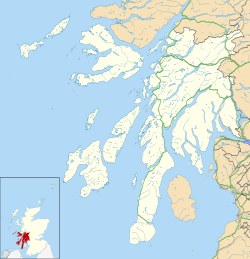
Argyll and Bute
Argyll and Bute (Scots: Argyll an Buit; Scottish Gaelic: Earra-Ghàidheal agus Bòd, pronounced [ɛrˠəˈɣɛːəl̪ˠ akəs̪ ˈpɔːtʲ]) is one of 32 unitary council areas in Scotland and a lieutenancy area. The current lord-lieutenant for Argyll and Bute is Jane Margaret MacLeod (14 July 2020). The administrative centre for the council area is in Lochgilphead at Kilmory Castle, a 19th-century Gothic Revival building and estate. The current council leader is Councillor Jim Lynch.
Argyll and Bute covers the second-largest administrative area of any Scottish council. The council area adjoins those of Highland, Perth and Kinross, Stirling and West Dunbartonshire.

2.8 km
Cairnbaan
Cairnbaan (Scottish Gaelic: An Càrn Bàn) is a village situated on the Crinan Canal, in Argyll and Bute, western Scotland.
Cairnbaan is about halfway between Ardrishaig on Loch Gilp at the canal's eastern end and Crinan on the Sound of Jura to the west. Its name, from Scottish Gaelic, means white hill or white cairn. On the hill above the village there are cup and ring marks dating from the Iron Age.
The Cairnbaan Hotel was built in about 1800 to cater for canal travellers. It was once a temperance hotel. It has featured in the television series The Tales of Para Handy, based on the novels of Neil Munro.

2.8 km
Loch a' Bharain
Loch a' Bharain (the Baron's Loch) is an impounding reservoir in Scotland.
Loch a' Bharain directly sits on the north bank of the Crinan Canal beside lock no.9, 1.5 kilometres (0.93 mi) west of Cairnbaan, and acts as a side pound to the summit reach: effectively increasing the area and therefore reducing the level changes caused by downward lockings at either end.
The earth-fill dam is 5.6 metres (18 ft) high and was constructed in 1801 during the construction of the Crinan Canal. Works were completed by 1810 and after further repair and inspection by 1815–1820 the Crinan canal helped bring jobs and industry to the area shortening what would be a longer voyage on boat to get to Crinan and other areas on the west coast. The 9 mile canal became known as a Royal Route when Queen Victoria sailed the canal after works completed, this was part of her tour of Scotland.
Loch á Bharain is one of the many many lochs (lakes) and burns (rivers) feeding the Crinan Canal. When the Crinan Canal was drained for repair and inspection in 2020–2021, Loch á Bharain was mostly drained, revealing old lock gates, tyres and other bits and pieces as well as the remains (floor plan) of the old castle of Clan McTavish.
The loch is regularly used by Mid Argyll Radio Sailing for model boats.

2.9 km
Ballymeanoch
Ballymeanoch (Scottish Gaelic: Baile Meadhonach - the middle settlement) is a complex of Neolithic structures located in Kilmartin Glen, Scotland.
It includes an avenue of two rows of standing stones with 4 and 2 stones each, a stone circle, and a henge with a small burial cairn. According to the Historic Environment Scotland marker at the site, the circle and standing stones are the older structures and their construction dates back to over 4,000 years ago. The tallest stone is 4 metres (12 feet) height. The two middle stones of the four stone line are heavily carved with cup and ring marks. The complex is designated a scheduled monument by Historic Environment Scotland.
The structures are located on a privately owned sheep farm but can be accessed via a series of paths that run between fences. The site is adjacent to the Dunchraigaig cairn for which there is a car park along the road.