

 English
 Français

Scorton Grammar School
Scorton Grammar School is a former grammar school that was located in Scorton village, in Richmondshire, North Yorkshire, England.
Nearby Places View Menu

242 m
Scorton, North Yorkshire
Scorton is a village and civil parish in the county of North Yorkshire, England. It is approximately 8 miles (13 km) north-west of the county town of Northallerton.
841 m
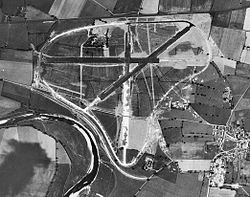
RAF Scorton
Royal Air Force Scorton or more simply RAF Scorton is a former Royal Air Force satellite station located next to the village of Scorton in North Yorkshire, England. The base was opened in October 1939 as part of 13 Group RAF Fighter Command and a satellite station of RAF Catterick. It was used by the Royal Air Force, the Royal Canadian Air Force, and the United States Army Air Forces Ninth Air Force during the war.
The famous No. 56 Squadron RAF flew Supermarine Spitfires from Scorton during the Second World War. Also the USAAF 422d and 425th Night Fighter Squadrons were stationed at Scorton flying the Northrop P-61 Black Widow fighter.
After the war, it was kept for a while as a Maintenance Unit base, then disposed of in the 1950s. It is now a site of gravel extraction.

890 m
Bolton-on-Swale
Bolton-on-Swale is a village and civil parish in the county of North Yorkshire, England. In 2015, North Yorkshire County Council estimated the population of the civil parish to be 70.

966 m
St Mary's Church, Bolton-on-Swale
St Mary's Church is the parish church of Bolton-on-Swale, a village in North Yorkshire, in England.
The oldest parts of the current church are the south aisle and south doorway, which date from the early 14th century. The chancel and vestry are 15th century, while the tower dates from about 1550. It was heavily restored by George Fowler Jones in 1857, the work including rebuilding much of the nave, most of the windows, and replacing the roof. The chancel was remodelled in 1877 by Eden Nesfield. The church was grade II* listed in 1969.
The church is built of sandstone with Westmorland slate roofs. It consists of a nave, north and south aisles, a chancel with a north vestry and organ chamber, and a west tower. The tower has three stages, diagonal buttresses, a southeast stair turret, a three-light west window, a clock face on the west side, two-light bell openings, with cinquefoil heads, continuous decorated lintels and hood moulds, and an embattled parapet with coats of arms.
Inside the church is a 14th-century piscina, in the south aisle. The sanctuary has decorative tiles made by Nesfield with a mural above depicting angels ascending to Heaven, while the Carpenter chapel has similar tiling, with bas relief plasterwork depicting maritime and pastoral scenes from the Bible. In the south wall are part of four Mediaeval tomb slabs, while next to the pulpit is part of an Anglo-Danish cross shaft. There is a large black marble slab commemorating Henry Jenkins, who died at the supposed age of 169.