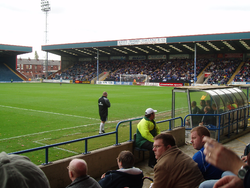
Spotland ( SPOT-land) is a district of Rochdale in Greater Manchester, England. The Rochdale ward name is Spotland and Falinge. The population of this ward at the 2011 census was 10,805. It lies on the River Spodden, and is the home of Spotland Stadium. Historically a part of Lancashire, Spotland was formerly its own township and chapelry within the ancient parish of Rochdale, in 1866 Spotland became a separate civil parish, in 1894 the parish was abolished to form Rochdale, Whitworth, Bacup and Norden. In 1891 the parish had a population of 37,828. The name Spotland means "area around the Spodden", Spodden referring to the River Spodden, which itself means "spouting stream". Spotland Primary School lies within the locality on Edmund Street.

Nearby Places View Menu
Location Image
525 m

River Spodden

The River Spodden is a watercourse in North West England, one of two major tributaries of the River Roch. It rises in the Lancashire South Pennine hills north of Whitworth and flows south through what is now known as the Whitworth Valley to Rochdale, Greater Manchester, where the river merges with the River Roch. Nestled within the picturesque wooded valley is Healey Dell Nature Reserve.
Location Image
544 m

Spotland Stadium

Spotland Stadium, known as the Crown Oil Arena for sponsorship reasons, is a multi-purpose sports stadium in the Spotland district of Rochdale, Greater Manchester, England, which is home to Rochdale Association Football Club and the Rochdale Hornets Rugby League Football Club. The venue has a capacity of 10,249.
Location Image
548 m

College Bank

College Bank, known locally as the Seven Sisters, is a group of seven residential tower blocks in Rochdale, Greater Manchester, England. Built in the 1960s, the towers are a prominent feature of the town's skyline and a symbol of post-war urban regeneration. In recent years, College Bank has faced significant challenges, including structural deterioration and safety concerns. In 2017 Rochdale Boroughwide Housing (RBH) proposed demolishing four of the towers, prompting strong opposition from residents and the formation of a campaign group. Following the death of two-year-old Awaab Ishak in a nearby RBH-managed property in 2020, RBH was placed under special measures, limiting its ability to secure funding for repairs to College Bank. In 2025 an independent structural survey deemed all seven towers unsafe, leading to plans for full evacuation in the coming months and growing uncertainty over the estate's future.
Location Image
595 m

St Edmund's Church, Rochdale

Saint Edmund's Church (or the Church of Saint Edmund) is a redundant church building located on Clement Royds Street in the Falinge area of Rochdale, in Greater Manchester, England. Commissioned by Rochdale's local industrialist and Freemason Albert Royds, the construction of the building was completed to a high and rich specification in 1873, with an "enormous" cost of around £25,000 (£2.8 million in 2023). It is the only known church building in England so overtly dedicated to Masonic symbolism and is therefore unique within English architecture. Art critic Nikolaus Pevsner described the building as "Rochdale's temple to Freemasonry, a total concept as exotic as Roslin Chapel in Scotland". Because of the building's craftsmanship, design and prevalent Masonic theme, St Edmund's Church was recorded in the National Heritage List for England as a designated Grade II* listed building in 1985. The church closed for worship in 2007, and in 2009, The Victorian Society identified the building as "unusual and extraordinary" but also critically endangered. St Edmund's heritage status was upgraded to a Grade I listing in 2010 in recognition of its unique Masonic architecture and exceptional architectural interest. It has since been acquired by the Churches Conservation Trust.