


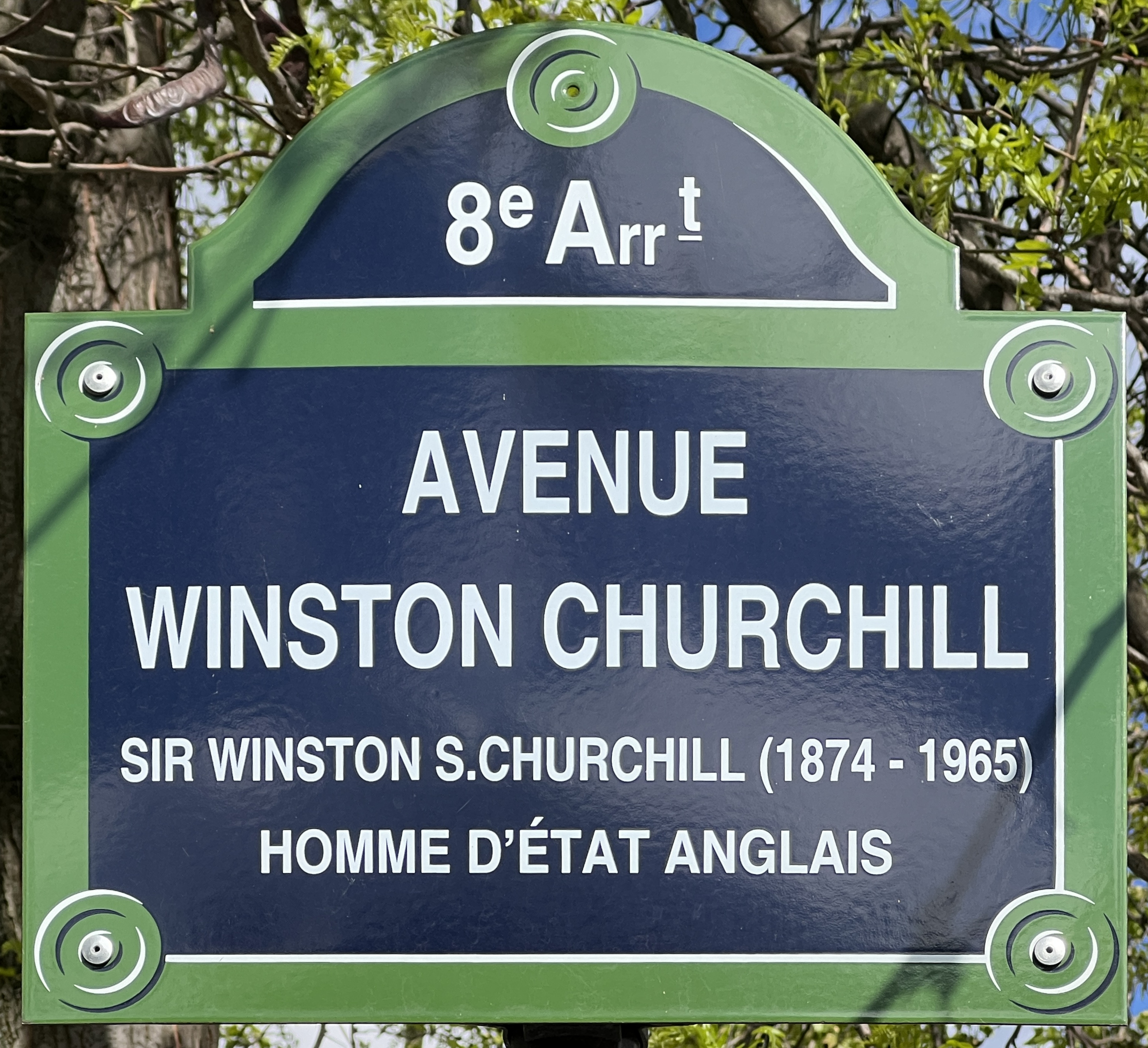
L'avenue Winston-Churchill est une voie du 8e arrondissement de Paris, en France.
Book your tour near
Avenue Winston-Churchill
Book Now
4.4
in partnership with
GetYourGuide.com
Gallery



Sponsored
Location
52 m
The Petit Palaisti palɛ]; English: Small Palace) is an art museum in the 8th arrondissement of Paris, France.
Built for the 1900 Exposition Universelle, it now houses the City of Paris Museum of Fine Arts. The Petit Palais is located across from the Grand Palais on the former Avenue Nicolas II, today Avenue Winston-Churchill. The other façades of the building face the Seine and Avenue des Champs-Élysées.
The Petit Palais is one of fourteen museums of the City of Paris that have been incorporated since 1 January 2013 in the public corporation Paris Musées. It has been listed since 1975 as a monument historique by the Ministry of Culture.

84 m
The Palais de l'Industrie was an exhibition hall located in Paris between the Seine River and the Champs-Élysées, which was erected for the Paris World Fair in 1855. This was the last of several buildings with the same name erected on the same site. The first Palais de l'Industrie was built in 1839 and was replaced for subsequent exhibitions in 1844 and 1849. The 1855 building was mainly designed by the architect Jean-Marie-Victor Viel and the engineer Alexis Barrault. It was demolished in 1897 to make way for the Grand Palais of the World Fair in 1900.
Emperor Napoleon III wished the World's Fair of 1855, which followed London's Great Exhibition by four years, to prove the superiority of the French by surpassing the British fair in every way. In particular, he desired a spectacular exhibition hall to rival The Crystal Palace. A competition held in 1852 was won by a plan by architect Jean-Marie-Victor Viel and engineer Desjardin, which combined the traditional use of masonry with that of cast iron. Due to cost constraints, however, the plans had to be reworked, for which the engineer Alexis Barrault is credited. In the final design, masonry was used only for the exterior walls, which were to be one metre thick and eighteen metres high. However, these massive walls were barely able to support the weight of the projecting cornice, and had to be reinforced with cast iron columns and beams.
The Palace of Industry was 260 metres long and 105 metres wide. Its principal nave was 190 metres long, and 48 metres wide. It was surrounded on four sides by aisles two stories high, and 30 metres wide. Its semi-circular trusses bridged a 24-metre span to create an enormous exhibition room. Despite its immense size, the palace was not large enough to house all of the expected exhibitors, so that two temporary buildings were constructed to house the remaining displays. The main failure of the building, which was not completed by the day the World Fair opened, was its poor ventilation. Although this made the building extremely hot during the day, it served as a hall for numerous exhibits and social events until its demolition in 1897.
Octave Mirbeau, commenting on the Palais de l'Industrie as a focal point of the Champs Elysées, compared the building to "an ox trampling through a rose garden." Although critics nearly universally condemned the Gothic "heaviness" of the building, the sheathing of an iron and glass structure with a stone casing was imitated in the London Exposition of 1862 and the World Columbian Exposition in Chicago, and even in the buildings that were to replace it: the Grand Palais and Petit Palais built for the 1900 World Fair.
The entrance of the Palais de l'Industrie was crowned by Élias Robert's sculpture group France crowning Art and Industry.
97 m
A statue of Winston Churchill by Jean Cardot was inaugurated in the grounds of the Petit Palais on the Avenue Winston Churchill in the 8th arrondissement of Paris in 1998. The statue of the former British prime minister is one of few statues of foreigners in the French capital.

99 m
Paris Photo is an annual international art fair dedicated to photography and image-based art. It was founded in 1997, and is held in November at the Grand Palais exhibition hall and museum complex, located near the Champs-Élysées in the 8th arrondissement in Paris.
The fair consists of photo-based artwork alongside a public programme of exhibitions, prizes, art signings and talks. It includes five sectors, including a "Voices", "Digital", "Emergence" and "Book".
The fair starts with a Vernissage, by invitation only, on Wednesday, followed by the main fair on Thursday to Sunday.

100 m
The Grand Palais des Champs-Élysées, commonly known as the Grand Palais, is a historic site, exhibition hall and museum complex located in the 8th arrondissement of Paris between the Champs-Élysées and the Seine, France, on Avenue Winston-Churchill. Construction of the Grand Palais began in 1897 following the demolition of the Palais de l'Industrie to prepare for the Universal Exposition of 1900. That exposition also produced the adjacent Petit Palais and Pont Alexandre III.
The building was designed to be a large-scale venue for official artistic events. A pediment on the building refers to this function with an inscription that reads, "a monument dedicated by the Republic to the glory of French art." Designed according to Beaux-Arts tastes, the building features ornate stone facades, glass vaults and period innovations that included iron and light steel framing and reinforced concrete.
It is listed as a historic monument by the Ministry of Culture.