

 English
 Français

Corinthian Club
Le Corinthian Club est un club privé situé à Ingram Street, Glasgow, en Écosse. Il est installé dans l'ancien bâtiment de la banque qui, sous le nom de Lanarkshire House, est devenu le siège du Lanarkshire County Council. C'est un bâtiment classé de catégorie A.
Nearby Places View Menu
242 m
Glasgay! Festival
Glasgay! Festival was a gay, lesbian, bisexual and transgender arts festival in Glasgow, Scotland. From 1993 to 2014, it was part of the diversity of Glasgow's cultural scene, an annual Lesbian, Gay, Bisexual and Transgender Arts Festival held usually in October/November, formerly organised by GALA Scotland Ltd.
288 m
The Ramshorn
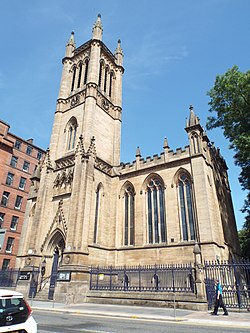
The Ramshorn (formerly St David's Parish Church), is a deconsecrated church building located on Ingram Street in the Merchant City area of Glasgow, Scotland. It is home to SCILT, Scotland's National Centre for Languages and the Confucius Institute for Scotland's Schools (CISS), both centres within the University of Strathclyde. The building is owned by the University, which bought the church in 1983 and used it as a theatre and performance space from 1992 until 2011.
The former church building sits within the Ramshorn Cemetery, one of Glasgow's oldest burial grounds.

297 m
Candleriggs
Candleriggs is a street in the city of Glasgow, Scotland. It is located in the Merchant City area of the city centre.
Candleriggs was historically the area of the old city of Glasgow where candlemakers plied their trade, at a safe distance from the crowded tenements clustered around the High Street. As the city expanded in the eighteenth century it became a thriving thoroughfare itself, lined with tenements and businesses typical of Glasgow at that time.
Looking down Candleriggs from its northern junction with Ingram Street, stands St David's, later known as Ramshorn Kirk. It had been without a congregation for a long while before being purchased by the University of Strathclyde in 1982. The church dates from 1826, built in Gothic Revival style by an English architect, Thomas Rickman, whose plans featured the large central tower which dominates the structure. It now serves as the home for the University of Strathclyde's Confucius Institute for Scotlands Schools and Scotland's National Centre for Languages.
Candleriggs is perhaps best known as the site of the City Halls, a musical venue operated by Glasgow City Council, home to the BBC Scottish Symphony Orchestra and a regular Glasgow performance base for the Scottish Chamber Orchestra. It is the older purpose-built concert hall in Glasgow.
The old Candleriggs Fruit Market building at the corner of Candleriggs and Bell Street housed a market for many years. With the opening of a purpose-built facility in May 1969, on the site of the old Blochairn Steelworks, it closed and was redeveloped as a complex housing pubs and restaurants which was renamed "Merchant Square".
Towards the southern end of Candleriggs was the Goldbergs department store, which closed in 1991. It was then taken over by Vera Weisfeld (of What Every Woman Wants fame) and reopened in 1994 as Weisfelds - a budget clothing store. Weisfeld's closed in 1999.
Granny Black's was a well known pub on Candleriggs housed in an old tenement building which collapsed due to a burst water main in the basement one night in February 2002. The building was empty at the time of the incident and there were no reported injuries.
The site subsequently fell into dereliction and the land was acquired by the luxury retailer Selfridges of London, although their plans to build a department store there were later dropped. In late 2013, Selfridges began demolition of the former Goldbergs buildings and works began in early 2014 to landscape the area. Following Selfridges selling land to a property developer, approval was granted in May 2020 for mixed-use development of the site by Drum Property. The first phase of the development will include a 500-room hotel and 300 apartments and is currently under construction.

317 m
Glasgow City Halls
Glasgow's City Halls and Old Fruitmarket is a concert hall and former market located on Candleriggs, in the Merchant City, Glasgow, Scotland.

318 m
Ramshorn Cemetery
The Ramshorn Cemetery is a cemetery in Scotland and one of Glasgow's older burial grounds, located within the Merchant City district, and along with its accompanying church, is owned by the University of Strathclyde. It has had various names, both official and unofficial: North West Parish Kirkyard; St David's Kirkyard; and Ramshorn and Blackfriars. The latter name tells of its link to Blackfriars Church, linking in turn to the pre-Reformation connection to the Blackfriars Monastery in Glasgow.
The burial ground was used from 1719 to 1915. In the 20th century it was remodelled along the lines of the London Improvements Act, moving most stones to the perimeter to create a usable park area. Apart from some flat stones still remaining in-situ this has largely disconnected the stones to the actual spot of interment.
In 1813 the body of Janet McAlister was stolen from the graveyard, being found with 4 others in College Street Medical School.
In 1824 the church of St David was built on its southern side, designed in a fine Gothic style by the English architect Thomas Rickman, with modifications by local architect James Cleland.
The cemetery is effectively in three sections: the original cemetery; an enclosed central walled area where the old church stood; and two small walled sections flanking the new church. Unusually monuments adopt only two forms: wall monuments and flat slabs, other than a small row of small 18th-century stones upright but partly sunk into the ground, standing in a line to the north-east.
Despite its great simplicity, the majority of graves are to rich Glasgow merchants. The austere style reflects Scottish Calvinist views.
John Anderson, the founder of Anderson's Institute - which would evolve into the Royal College of Science and Technology and then ultimately the University of Strathclyde, is also interred in the site.