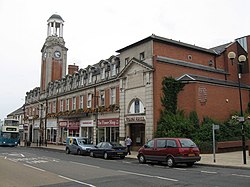
Tudhoe is a village in the civil parish of Spennymoor, in County Durham, England. It lies just outside Spennymoor, a short distance to the west of the Great North Road. Tudhoe lay at the centre of a network of roads: one ran to Durham by way of Sunderland Bridge and Croxdale, another to Kirk Merrington, a third to Bishop Auckland, a fourth to Whitworth and Byers Green, and a fifth across a ford to Brancepeth Castle and village on the far side of the river. All except the Brancepeth road are shown on the 1768 map of County Durham by Thomas Jefferys. Tudhoe is now dwarfed by Spennymoor, an industrial town that grew up around the Tudhoe iron works in the 19th century. The modern town of Spennymoor lies only a few fields from Tudhoe, but the contours are such that it cannot be seen from most of the village, and Tudhoe today gives the impression that it is still an isolated country village. For most of its history, Tudhoe has been in the parish of Brancepeth. The parish church of St Brandon's, dating from the 16th century, was one of the finest village churches in County Durham until its destruction by fire in 1998. Brancepeth lies across the River Wear from Tudhoe; there has never been a bridge, and the ford was not an easy one. In winter, it was often impassable, and Tudhoe baptisms, weddings and burials then took place at Whitworth. Because of this, Tudhoe was always seen (from Brancepeth) as an isolated outpost. Tudhoe's own Anglican churches, Holy Innocents and St David's, were not built until 1866 and 1880, respectively, though there is a large Catholic church, dedicated to St. Charles Borromeo, which was founded in 1858. Tudhoe was renowned as a mining village until the end of the 20th century. Until the closure of the mines, the wealthy Colliery Masters took up residence in a grand mansion known as The Loggins, which stands in several acres of its own land and overlooks the area.

Nearby Places View Menu
678 m

Mount Pleasant, Spennymoor

Mount Pleasant is a village in County Durham, England. It is situated immediately to the north-east of Spennymoor, close to Tudhoe.
Location Image
1.0 km

Spennymoor Town F.C.

Spennymoor Town Football Club is a football club based in Spennymoor, County Durham, England. The team currently compete in the National League North, the sixth level of the English football league system. They currently play their home matches at The Brewery Field. The club began playing in the Northern League in 1931–32 as Evenwood Town, reaching the first round of the FA Cup in the 1956–57 season. In 2005, the club merged with Spennymoor United, who had folded earlier that year, and collectively changed their name to Spennymoor Town. They won the Northern League Division Two division in 2006–07. Spennymoor then won the Northern League division four times before joining the Northern Premier League in 2014 as well as winning the FA Vase in 2012–13. Spennymoor then won two automatic promotions via the play-offs to reach the National League North by 2017.
Location Image
1.1 km

Spennymoor

Spennymoor is a town and civil parish in County Durham, England. It is south of the River Wear and is 7 mi (11 km) south of Durham. The civil parish includes the villages of Kirk Merrington, Middlestone Moor, Byers Green and Tudhoe. In 2011 the parish had a population of 19,816.
Location Image
1.1 km

Diocese of Durham

The diocese of Durham is a diocese of the Church of England in North East England. The boundaries of the diocese are the historic boundaries of County Durham, meaning it includes the part of Tyne and Wear south of the River Tyne and contemporary County Durham north of the River Tees. It contains 249 parishes and 292 churches. Durham Cathedral is the seat of the bishop of Durham, and the diocesan offices are located just outside the city at Stonebridge. The bishop lives in Bishop Auckland and has offices in Auckland Castle. The diocese is the successor to the diocese of Lindisfarne, founded in 635, which moved its seat to Chester-le-Street in 882 and subsequently moved again to Durham in 995. Most of Northumberland and the part of Tyne and Wear north of the Tyne were part of the diocese until 1882, when the diocese of Newcastle was created.