

 English
 Français

45 Commando
45 Commando Royal Marines (pronounced "four-five commando") is a battalion sized unit of the British Royal Marines and subordinate unit within UK Commando Force, the principal Commando formation, under the Operational Command of the Fleet Commander. Tasked as a Commando amphibious unit, 45 Cdo RM is capable of a wide range of operational tasks. Based at RM Condor, their barracks in Arbroath, personnel regularly deploy outside the United Kingdom on operations or training. All personnel have completed the Commando course at the Commando Training Centre at Lympstone in Devon, entitling them to wear the green beret, with attached personnel having completed the All Arms Commando Course.
Nearby Places View Menu

312 m
RM Condor
RM Condor is a large Royal Marines base located near Arbroath in East Angus, Scotland. The base also houses 7 (Sphinx) Battery Royal Artillery, part of 29 Commando Regiment Royal Artillery.

2.0 km
Colliston
Colliston is a roadside hamlet in Angus, Scotland that is four miles north of Arbroath on the A933 Arbroath to Brechin road, in the parish of St Vigeans.
2.4 km
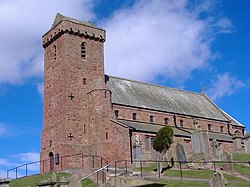
St Vigeans
St Vigeans is a small village and parish in Angus, Scotland, immediately to the north of Arbroath. Originally rural, it is now more or less a suburb of the town of Arbroath.

2.4 km
St Vigeans Sculptured Stones Museum
St Vigeans Sculptured Stones Museum, located in the Angus village of St Vigeans, houses an outstanding collection of Pictish carved stones. St Vigeans, close to Arbroath, was the centre of a royal estate in the Early Middle Ages, and was of religious importance as a monastery founded in the 8th century. The present-day St Vigeans Church was built in the 12th century, on a 40-foot (12 m) mound.
The museum displays 38 carved stones which formerly stood upon the old church mound. Among the stones on display is the 9th-century Drosten Stone, a flat rectangular slab with a cross carved on one side and Pictish symbols on the other, and also bearing a Pictish inscription in Latin script. The museum is managed by Historic Scotland and is housed in two adjoining sandstone cottages close to the church. The 19th-century cottages are a category B listed building.