


Wolstenholme Towne was an English settlement in the Colony of Virginia, 7 miles (11 km) east of the colonial capital, Jamestown. One of the earliest English settlements in the New World, the town existed for roughly four years until its destruction in the Indian massacre of 1622. The Wolstenholme Towne site was later built upon by the Carter's Grove plantation in 1750 and is located within the present-day community of Grove, Virginia, United States.
Location
1 explorer visited this place
0 m
Martin's Hundred was an early 17th-century plantation located along about ten miles of the north shore of the James River in the Virginia Colony east of Jamestown in the southeastern portion of present-day James City County, Virginia. The Martin's Hundred site is described in detail in the eponymous book of Ivor Noel Hume first published in 1979.

2.2 km
The Matthew Jones House is a historic plantation house located on Fort Eustis in Newport News, Virginia. The house sits on a hill toward the northern end of Mulberry Island, overlooking the James River. It was built ca. 1725 as a one-and-a-half-story frame dwelling with brick chimneys and later underwent two major renovations. During the first renovation, in 1730, the walls were bricked in and a shed room and porch tower were added. During the second, in 1893, the house was raised to a full two stories. In 1918 the house and its surrounding land were acquired by the U.S. government for the establishment of an army post. By the late twentieth century, the Matthew Jones House had fallen into grave disrepair. In 1993 it was preserved and rehabilitated by the National Park Service in cooperation with the U.S. Army Corps of Engineers. Today it serves as an architectural museum.
At times in the past the Matthew Jones House was also known as the "Brick House" for its construction, and the nearby creek, now known as Milstead Creek, was once called Brick House Creek. It is frequently stated in popular histories of the area and on the Matthew Jones House roadside historical marker that the plantation was once known as "Bourbon".
2.4 km
The Queen Hith Plantation Complex Site is a historic archaeological site in the Oakland Farm area of Newport News, Virginia. It is the site of the central complex of Thomas Harwood's extensive plantation, established some time after his arrival at Jamestown in 1622. The plantation was about 1,500 acres in size, and extended along both banks of Skiffe's Creek. The site includes the foundational remnants of his 1643 house.
In modern times, the site is owned by the City of Newport News and is not open to the public.

2.7 km
The Fort Eustis Military Railroad is an intra-plant United States Army rail transportation system existing entirely within the post boundaries of the United States Army Transportation Center and Fort Eustis, Fort Eustis, Virginia. It has served to provide railroad operation and maintenance training to the US Army and to carry out selected material movement missions both within the post and in interchange with the US national railroad system via a junction at Lee Hall, Virginia. It consists of 31 miles of track broken into three subdivisions with numerous sidings, spurs, stations and facilities.
The Utility Rail Branch of the Fort Eustis Military Railway continues to operate today under the command of the 733RD Logistics Readiness Division, Joint-Base Langley Eustis. The Utility Rail Branch of the Fort Eustis Military Railroad joined Operation Lifesaver in 2010.
3.4 km
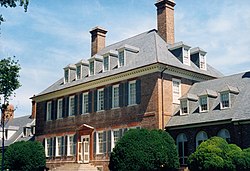
Carter's Grove, also known as Carter's Grove Plantation, is a 750-acre plantation located on the north shore of the James River in the Grove Community of southeastern James City County in the Virginia Peninsula area of the Hampton Roads region of Virginia in the United States.
The plantation was built for Carter Burwell, grandson of Robert "King" Carter, and was completed in 1755. It was probably named for both the prominent and wealthy Carter family and nearby Grove Creek. Carter's Grove Plantation was built on the site of an earlier tract known as Martin's Hundred which had first been settled by the English colonists around 1620. In 1976, an archaeological project discovered the site of Wolstenholme Towne, a small settlement downstream a few miles from Jamestown which had been developed in the first 15 years of the Colony of Virginia. The population of the settlement was decimated during the Indian massacre of 1622.
After hundreds of years of multiple owners and generations of families, and the death of the last resident in 1964, Carter's Grove was added to Colonial Williamsburg Foundation's properties through a gift from the Rockefeller Foundation in 1969.
Carter's Grove was open to tourists for many years but closed its doors to the public in 2003 while CW redefined its mission and role. Later that year, Hurricane Isabel seriously damaged Carter's Grove Country Road, which had linked the estate directly to the Historic Area, a distance of 8 miles, bypassing commercial and public roadways. CW then shifted some of the interpretive programs to locations closer to the main Williamsburg Historic Area and announced in late 2006 that it would be offered for sale under specific restrictive conditions, including a conservation easement.
In December 2007, CNET founder Halsey Minor acquired the Georgian style mansion and 476 acres for $15.3 million and announced plans to use it as his home and for a thoroughbred horse breeding program with the Phipps family. The Virginia Outdoors Foundation and the Virginia Department of Historic Resources co-hold the conservation easement on 400 of the 476 acres. However, Minor never lived at the property and filed for personal bankruptcy in 2013. The Colonial Williamsburg Foundation submitted the only bid at the auction held on May 21, 2014, for the outstanding mortgage amount, and announced that it planned to resell it, with a price increased because of significant costs related to the sale, including over $600,000 in necessary repairs. Samuel M. Mencoff, a founder of Madison Dearborn Partners, acquired the property later in 2014.