


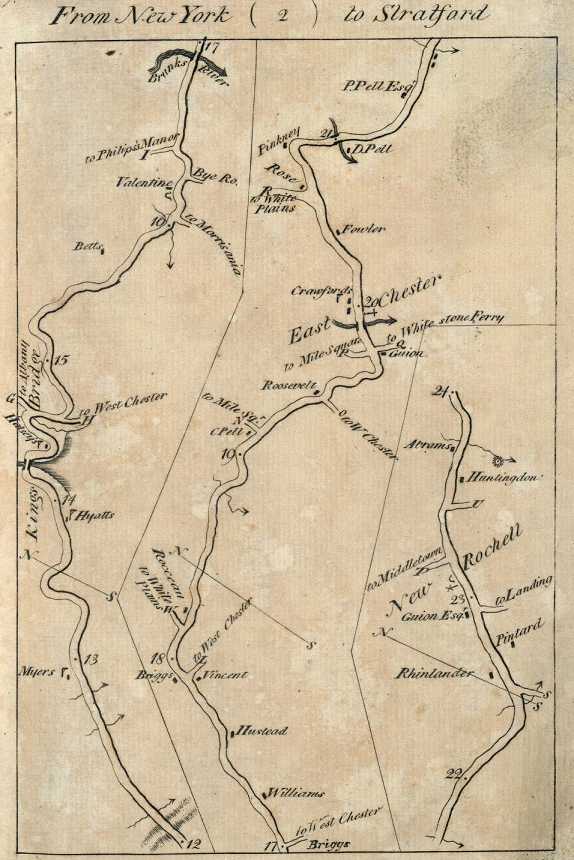
Middletown is a former hamlet of the Town of New Rochelle in Westchester County, New York.
Location
1 explorer visited this place

21 m
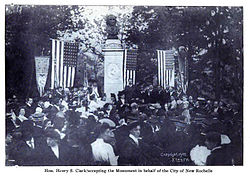
The Jacob Leisler Monument is a bronze sculpture created by American artist Solon Borglum and located in the city of New Rochelle, in Westchester County, New York. The monument was erected by the Huguenot Chapter of the Daughters of the American Revolution, and the Huguenot Association of New Rochelle to the memory of Jacob Leisler, 17th-century advocate of the Huguenot settlers and said to be the first chief executive of the province of New York to draw his power directly from the people. The unveiling of the statue on June 24, 1913, was the principal event in the celebration of the 250th anniversary of the founding of New Rochelle. The monument, cast by the Roman Bronze Works, is the only existing statue of Leisler.
Jacob Leisler was German-born and came to North America in 1660 as a soldier in the Dutch West India Company's service. Settling in New Amsterdam, he left the company and prospered in the tobacco and fur trades, becoming a wealthy merchant and being appointed to several public offices in the city, such as justice of the peace and judge. Beginning in 1689, following the English Revolution in 1688 and accession of the Protestant rulers William III and Mary II, he led an insurrection dubbed Leisler's Rebellion, with popular support among the common people, ultimately seizing control of the city and colony from Jacobite officials previously appointed under the deposed King James. He appointed himself as acting Lieutenant Governor of the Province until the governor appointed by William and Mary finally reached New York in March 1691. During this period, he had purchased land from Pelham Manor, reserving a portion to help create the Huguenot settlement of New Rochelle in 1689. He refused to turn over power to a newly appointed lieutenant governor in 1690.
Leisler in 1691 was arrested and tried by his personal and political enemies on charges of felony and treason to William III and Mary II, for refusing to give up power to their appointed Lieutenant Governor before the full governor arrived several months later. He and his son-in-law were both executed. Many thought the trial was unjust. Four years later, Parliament reversed the conviction, clearing Leisler's name and restoring his estate to his heirs. They exonerated the late friend of the Huguenots.

188 m
The Thomas Paine Cottage in New Rochelle, New York, in the United States, was the home from 1802 to 1806 of Thomas Paine, author of Common Sense, U.S. Founding Father, and Revolutionary War hero. Paine was buried near the cottage from his death in 1809 until his body was disinterred in 1819. It was one of a number of buildings located on the 300 acre farm given to Paine by the State of New York in 1784, in recognition of his services in the cause of Independence. It was here in August 1805 that he wrote his last pamphlet, which was addressed to the citizens of Philadelphia on "Constitutional Reform".
The cottage has been owned by the "Huguenot and New Rochelle Historical Association" and has been operated as a historic house museum since 1910. The cottage is open to the public most Fridays, Saturdays and Sundays 10–5 p.m.. There are numerous weekend events scheduled at the cottage throughout the year including their Colonial Fair in the spring and Colonial Tavern night during ArtsFest in October and a Toys for Tots drive in December. The cottage hosts many local school field trips.
203 m
The Thomas Paine Monument located in New Rochelle, New York is dedicated to the memory of Founding Father Thomas Paine. The monument stands on North Avenue at the entrance to Paine Avenue. This is the oldest extant memorial to Thomas Paine. The original monument erected in 1839 consisted of just the tapered marble pedestal and capital. A bronze bust of Paine was later added in 1899.

286 m
The Thomas Paine Historical Association is an organization based in New Rochelle, New York, that is dedicated to perpetuating the legacy of Founding Father Thomas Paine. It was organized on January 29, 1884, the anniversary of Paine's birthday, and is one of the oldest historical associations in the United States. It is one of two Thomas Paine legacy organizations based in New Rochelle, the other being the Thomas Paine Cottage Museum of the Huguenot and New Rochelle Historical Society, founded in 1886, which owns and maintains the Thomas Paine Cottage. In 2025, the US-based Thomas Paine National Historical Association and the UK-based Thomas Paine Society merged to form Thomas Paine Historical Association.
311 m
Mahlstedt's Ice Pond, commonly referred to as Huguenot Lake, is a man-made lake located in central New Rochelle in Westchester County, New York. Constructed in 1885, the lake is impounded by the Mahlstedt Reservoir Dam on a tributary of Pine Brook. The dam is of earthen construction and rock fill, with a height of 15 feet and a length of 7,000 feet. It has a normal surface area of 14 acres, a capacity of 70 acre-feet, and normal storage of 56 acre-feet.
For years the lake served as a water supply source for nearby Mount Vernon as well as a successful ice supply business.
Several generations of the Mahlstedt family harvested ice from the lake, however, after refrigeration made the once-lucrative business obsolete, the family sold the lake and adjoining property to the city in 1922. The lake is currently part of Huguenot Park and the New Rochelle High School campus. It is currently used for recreational and environmental purposes.
Book your tour near
Middletown
Book Now
4.0
in partnership with
GetYourGuide.com