


The Pflanzengarten Bad Schandau (6100 m2) is a botanical garden located in the Saxon Switzerland National Park on the Kirnitzschtalstraße (Kirnitzsch valley), Bad Schandau, Saxony, Germany. It is open daily from April to October. The garden opened in 1902 as the Regionalbotanischer Garten Sachsens (Saxon Regional Botanical Garden), with a goal of preserving local plants, including rare poisonous and medicinal plants.
Location

984 m
Reinhardtsdorf-Schöna is a municipality in the Sächsische Schweiz-Osterzgebirge district in the German federal state of Saxony. It has a population of approximately 1,600 and is located close to the Czech border in Saxon Switzerland, a popular tourist region.
Reinhardtsdorf-Schöna encompasses the villages of Reinhardtsdorf, Schöna and Kleingießhübel. The municipality of Reinhardtsdorf-Schöna was formed in 1973 from the merger of these three parishes.

1.2 km
Reinhardtsdorf Sandstone is quarried in the vicinity of Reinhardtsdorf near Pirna in the district of Sächsische Schweiz-Osterzgebirge in the German Free State of Saxony. It is the so-called main sandstone of the Elbe sandstones, and was formed in the Middle Turonian. In 2008 there was one quarry that won this particular sandstone.

1.8 km
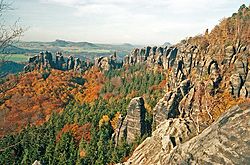
The Schrammsteine are a long, strung-out, very jagged group of rocks in the Elbe Sandstone Mountains located east of Bad Schandau in Saxon Switzerland in eastern Germany. To the north they are bordered by the Kirnitzsch valley, to the south by the Elbe valley and to the east by the Affensteine rocks. The high point of the chain lies at over 400 m above sea level. The viewing point on the Schrammsteine lies at a height of 417.2 m above HN.

1.9 km
The Krippenbach is a small river of Saxony, Germany. It is a left tributary of the Elbe, which it joins in Krippen, near Bad Schandau. It has an elevation of 136 meters. Its name comes from Krippen, a small fishing hamlet on the river. It was used to power mills in hamlets and villages for centuries. A moller was first mentioned in a document in Krippen in 1474.
As of 2002, it contained nearly 1000 taxa from cool and moist climates around the world, but focuses on plants of the Saxon Switzerland area, including 323 species from the area, of which about 80 species were protected or on Saxony's Red List.
Book your tour near
Pflanzengarten Bad Schandau
Book Now
4.0
in partnership with
GetYourGuide.com