Location Image

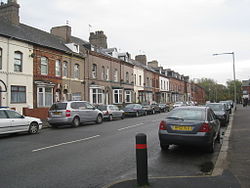
Parkside, Barrow-in-Furness

Parkside is an area, current Town Council ward and former district-level ward of Barrow-in-Furness, Cumbria, England. It is bordered by Hindpool, Ormsgill, Hawcoat, Newbarns and Risedale and had a population of 5,742 in 2001, reducing to 5,584 at the 2011 Census. It is one of the town's most centralised wards and contains Barrow's main park (hence the ward's name), as well as the newly established Furness Academy. Abbey Road - Barrow's principal road runs down the entire western side of Parkside. The majority of housing to the west of Abbey Road is terraced and semi-detached, whilst the eastern side of Parkside is predominantly parkland and fields with the exception of some semi and detached housing. Whilst still an electoral ward for Barrow Town Council, the ward was combined at a district/ local authority level with Ormsgill ward in April 2023 following formation of the new Westmorland and Furness Local Authority. There are a number of place of worship in Parkside including Abbey Road Baptist Church, Spring Mount Christian Fellowship and Trinity Church Centre. Barrow's first synagogue was founded in 1902 on Abbey Road although it closed less than twenty years later. Parkside's ward is of the first to have a Communist Party of Britain council member.

Nearby Places View Menu
Location Image
266 m

Furness Academy

Furness Academy is a secondary school in Barrow-in-Furness, England. It is the fourth academy to have been formed in the county of Cumbria after the closure of Alfred Barrow School, Parkview Community College of Technology and Thorncliffe School in 2009. Having utilised numerous buildings of the former Parkview and Thorncliffe Schools since 2009, a single £22 million building opened in the Parkside area of the town in September 2013. Since opening, Furness Academy has gained a somewhat tarnished reputation from having the highest exclusion rate in England (between 2009 and 2010), and a number of Ofsted reports that judged it as inadequate. The 2012 report led to the academy unsuccessfully challenging Ofsted in the High Court, and the 2013 report led to the school's being placed in 'special measures' and the suspension of the academy's principal. The school was successfully moved out of special measures in 2015. It also celebrated its best ever GCSE results in summer 2015. In 2019, Furness Academy successfully merged with the Inspired Learning Trust, to form Furness Education Trust. This multi academy Trust comprises Furness Academy, Parkside Academy, Victoria Academy, Yarlside Academy and South Cumbria School Direct.
317 m

Barrow Park

Barrow Park is a 45-acre public park in Barrow-in-Furness, Cumbria, England. It is located entirely within the Parkside ward, to which the park lends its name, bound by Abbey Road, Park Drive, Greengate Street and Park Avenue. Barrow Park was designed by Thomas Mawson in 1908 and was constructed in stages over the following two decades. Originally sited on the outskirts of Barrow, the park is now more or less central due to rapid growth of the town northwards during the early 20th century. It is designated by Historic England as Grade II on the Register of Historic Parks and Gardens. The park contains a large boating lake, mini railway, skate park, various playgrounds and The Park Leisure Centre. The Barrow Parkrun takes place within the park every Saturday. Large sections of Barrow Park were redeveloped in 2005 to include a new pavilion, café, bandstand and display glasshouse. The park has since gained Green Flag status. The miniature railway features a signal box taken, in 1974, from a line closed as part of the Beeching cuts. It underwent a round of restoration in late 2016.
Location Image
392 m

Barrow Park Cenotaph

The Barrow Park Cenotaph is the main war memorial in the UK town of Barrow-in-Furness, Cumbria, North West England. Located in Barrow's main public park, the structure is grade II listed. It is made from Portland limestone and is pillar like in appearance. It was built in 1919 in commemoration of the 616 Barrovian men who lost their lives in combat during World War I, however since then the names of 274 more locals have been added (268 of these being fatalities of World War II and 6 of the Korean War). The cenotaph currently only bears the names of Barrovians lost during these three wars whilst in military action (i.e. excluding civilians killed in the Barrow Blitz). Two inscriptions on the memorial read, To the glory of God and in honoured memory of the men of Barrow-in-Furness who fell in the Great War and in honoured memory of all service personnel who gave their lives in the 1939–1945 War. Also Korea and Cyprus campaigns having made the supreme sacrifice that we might live lest we forget.
558 m

Barrow-in-Furness power station

Barrow-in-Furness power station supplied electricity to the town of Barrow-in-Furness and the wider area of Lancashire, England from 1899 to about 1960. It was owned and operated by Barrow-in-Furness Corporation until the nationalisation of the UK electricity supply industry in 1948. The power station was redeveloped throughout its operational life. Barrow-in-Furness Corporation also operated Coniston hydro-electric power station.