


La Vieille Forteresse (en italien : Fortezza Vecchia), est une fortification située à la limite du port de Livourne, dans la province de Livourne en Toscane. Elle a subi des modifications et des reconstructions au fil des siècles, du Moyen Âge jusqu'au XXe siècle.
Gallery


Sponsored
Location

52 m
The Old Fortress of Livorno is a castle in Livorno, Italy. The Old Fortress is a successor building to a medieval fort built by the city of Pisa in the location of an older keep built by Countess Matilda of Tuscany in the 11th century. The 11th-century tower was incorporated inside the fort built by the Pisans. The castle has been described as a "symbol of Medicean Livorno". The fort is located at the Medicean Darsena, or old dock of the port of Livorno, built by the Medici family. The ceremony proclaiming Livorno a city took place inside the fortress on 19 March 1606.

303 m
San Ferdinando is a Baroque style, Roman Catholic church located in Venezia Nuova district next to Piazza del Luogo Pio in Livorno, region of Tuscany, Italy. It is also called San Ferdinando Re or the Church of the Crocetta. Nearby is the deconsecrated church of Sant'Anna.

307 m
The Monument of the Four Moors is located in Livorno, Italy. It was completed in 1626 to commemorate the victories of Ferdinand I of Tuscany over the Ottomans.
It is the most famous monument of Livorno and is located in Piazza Micheli. Created by Pietro Tacca, the monument takes its name from the four bronze statues of "Moorish" slaves that are found at the base of an earlier work consisting of the statue of Ferdinando I and its monumental pedestal.

311 m
San Giovanni Battista is a Baroque-Mannerist style, Roman Catholic church located at the crossing of Via San Giovanni and Via Carraia in central Livorno, region of Tuscany, Italy.
434 m
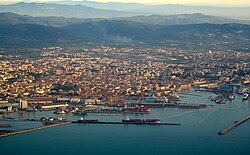
Livorno is a port city on the Ligurian Sea on the western coast of the Tuscany region of Italy. It is the capital of the Province of Livorno, having a population of 152,916 residents as of 2025. It is traditionally known in English as Leghorn.
During the Renaissance, Livorno was designed as an "ideal town". Developing considerably from the second half of the 16th century by the will of the House of Medici, Livorno was an important free port. Its intense commercial activity was largely dominated by foreign traders. Also the seat of consulates and shipping companies, it became the main port-city of the Grand Duchy of Tuscany. The high status of a multiethnic and multicultural Livorno lasted until the second half of the nineteenth century, when it was surpassed by other cities. Evidence of that prosperous time can be seen in the many churches, villas, and palaces of the city.
Livorno is considered to be the most modern among all the Tuscan cities, and is the third most-populous of the region, after Florence and Prato.
Book your tour near
Vieille Forteresse
→