

 English
 Français
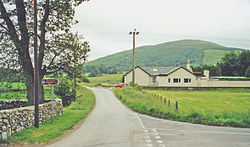
Killywhan railway station
Killywhan railway station served the hamlet of Killywhan, Dumfries and Galloway, Scotland from 1859 to 1959 on the Castle Douglas and Dumfries Railway.
Nearby Places View Menu

735 m
Beeswing, Dumfries and Galloway
Beeswing is a small village in the historical county of Kirkcudbrightshire in Scotland.

1.6 km
Loch Arthur
Loch Arthur (also known as Loch Lotus) is a lake in the council area of Dumfries and Galloway in Scotland near the village of Beeswing.
Loch Arthur lies to the east of the village of Beeswing and has been claimed as the setting for the Arthurian story of the Lady of the Lake.
Prehistoric lake dwellings (crannogs) were formerly on this lake. A logboat and possible paddle have been found.
Loch Arthur Camphill Community is a farm near the loch where people with disabilities, volunteers and staff produce organic cheese, butter and other foods.

1.7 km
Loch Arthur logboat
The Loch Arthur logboat or dugout canoe (also called Loch Arthur 1, Loch Lotus or Lotus Loch) was found in 1874 when the water level was low on the south bank of the Loch Arthur, near the village of Beeswing, southwest of Dumfries in Dumfries and Galloway in Scotland. The logboat, built of oak, is about 13.7 meters long and up to 1.5 meters wide. On the opposite side of the 300 to 400 meter wide lake was a crannóg (lake dwelling).
The Loch Arthur logboat or dugout canoe (also called Loch Arthur 1, Loch Lotus or Lotus Loch) was found in 1874 when the water level was low on the south bank of the Loch Arthur, near Kissock, southwest of Dumfries in Dumfries and Galloway in Scotland. The dugout, built of oak, is about 13.7 meters long and up to 1.5 meters wide. On the opposite side of the 300 to 400 meter wide lake was a crannóg (lake dwelling).
The logboat was damaged during recovery. The bow, including an ornamental animal head, was given to the Museum of Scotland. The surviving part of the sawed-up boat is 6.34 m long. The tail section and a paddle went to the Dumfries Museum and were lost there. The paddle was about 50mm in diameter and the end was decorated. The dugout canoe was built between 100 BC and AD 80.
The rear end formed from a bar was placed in a groove about 38 mm wide. At the end of the starboard side there were seven holes about 76 mm in diameter spaced about 1.5 m apart. The bottom of the boat was pierced with three irregular holes.
The starboard side survives to a height of 0.43 m. The remains did not suffer much from the split, but show strong faults. The bow of the boat has an unusual shape that ended in an extension that resembled the elongated neck and head of an animal. The hole that formed the “eye” was about 127 mm in diameter and was probably used for a line or rope. This feature has also been observed in the dugout canoes "Errol 2" and "Loch of Kinnordy". The pointed bow is notable for its internal gradation, which was probably left as reinforcement. This has no Scottish parallels, but is also found on three boats from Holme Pierrepont, in Nottingham, England to be found, one of which was dated between 230 BC and 110 BC.
Three bronze grapes had previously been found in the lake.

2.2 km
Drumcoltran Tower
Drumcoltran Tower is a late-16th-century tower house situated in the historical county of Kirkcudbrightshire near Kirkgunzeon, Dumfries and Galloway.
Like other towers in the area, Drumcoltran was built by a branch of the Maxwell family around 1570 but passed with the estate to the Irvings in 1668. The Maxwells however constructed the existing farm steading and made alterations to the interior of the tower in the 18th century.
It was designated a scheduled monument in 1928.