

 English
 Français

Denaby Main
Denaby Main est un village du district métropolitain de Doncaster, dans le Yorkshire du Sud en Angleterre.
Nearby Places View Menu
0 m
Denaby Main
Denaby Main is a village between Mexborough and Conisbrough in the Metropolitan Borough of Doncaster in South Yorkshire, England. The village falls within the Doncaster MBC ward of Conisbrough and Denaby. It was built by the Denaby Main Colliery Company to house its workers and their families, and originally given the name Denaby Main Colliery Village, to distinguish it from the village of Denaby, about 2⁄3 mi (1 km) away on the road to Hooton Roberts and Kilnhurst; from that time, the old village became known as Old Denaby. In due course the "Colliery Village" part of the name was lost, leaving the village to be known as Denaby Main.

0 m
Denaby Ings
Denaby Ings are a nature reserve on the River Dearne, encompassing an area of 23 hectares north of Denaby Main, Doncaster, South Yorkshire, near the town of Mexborough. The Trans Pennine Trail passes here. The habitats include open water, water meadows, woodland scrub and hedgerows. Birdwatching is a popular activity there. The area has been classed as a Site of Special Scientific Interest since 11 August 1983.
696 m
Mexborough Power Station
Mexborough Power Station was a coal-fired power station situated on the banks of the River Don, on the border of Mexborough and Denaby, adjoining Doncaster Road, in South Yorkshire, England.

762 m
Denaby and Conisbrough railway station
Denaby and Conisbrough railway station was a small station, the southern terminus of the South Yorkshire Junction Railway branch from Wrangbrook Junction. The station, built to serve Denaby Main and Conisbrough, near Doncaster, South Yorkshire, England, was situated just to the north of the Mexborough to Doncaster line of the Manchester, Sheffield and Lincolnshire Railway, close by the road linking the villages in its name. Access to the station was by a subway under the G.C. line.
The line, promoted by the Denaby and Cadeby Colliery Company, was operated by the Hull and Barnsley Railway and connected at Wrangbrook with its main line between Cudworth, near Barnsley, and Hull.
The station was a wooden structure and its facilities included a locomotive shed to house the branch tank locomotive. This was destroyed by fire.
Originally there was no connection with the M.S.& L. R. line, this was not put in place until Great Central days, opening on 13 July 1908 in order for that company to reach Brodsworth Colliery.
The next station northwards was Sprotborough (H&B) railway halt.
The station closed on 2 February 1903 when passenger services were withdrawn.
966 m
River Dearne
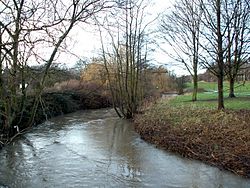
The River Dearne in South Yorkshire, England flows roughly east for more than 30 kilometres (19 mi), from its source just inside West Yorkshire. It flows through Denby Dale, Clayton West, Darton, Barnsley, Darfield, Wath upon Dearne, Bolton on Dearne, Adwick upon Dearne and Mexborough to its confluence with the River Don at Denaby Main. Its main tributary is the River Dove, which joins it at Darfield. The river was one of those affected by the 2007 United Kingdom floods.
The course of the river is accessible to walkers as the Dearne Way, a long distance footpath from Dearne Head to the river's junction with the Don. Places of interest along the Dearne include the Yorkshire Sculpture Park at West Bretton, and Monk Bretton Priory. The Dearne Valley below Barnsley is a regeneration area.
The river has been subject to channel engineering to ease the problem of flooding. A new channel was constructed near its mouth in the 1950s, as the old route had been affected by mining subsidence. Washlands, which can be progressively flooded as water levels rise, were constructed in the 1960s and 1970s. A flood relief channel and a regulator to restrict the flow was built at Bolton upon Dearne. During the 2007 United Kingdom floods, the washlands filled to capacity but the regulator could not be operated as it had been vandalised.
Industrialisation caused the river and the Dearne and Dove Canal, to become grossly polluted in the early nineteenth century and fish populations died. The West Riding River Board tried to address the problems in 1896 with limited success and much of the river remained dead until the 1980s, when industrial effluents were removed before they were discharged and improvements were made to sewage treatment. Despite setbacks, fish populations had been partially reinstated by the early 1990s. Channel engineering was carried out at Denaby in the 1990s, to re-introduce bends, deep pools and shallow gravel riffles, to assist fish spawning. In June 2015, salmon were reported in the river for the first time in 150 years.