

 English
 Français

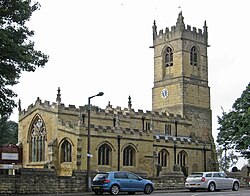
St Peter's Church, Barnburgh
St Peter's Church, Barnburgh is a parish church of the Church of England situated at the centre of the village of Barnburgh, near Doncaster in South Yorkshire. Famous for the legend of the 'Cat and Man', the church serves the communities of Barnburgh and Harlington.
Nearby Places View Menu
386 m
Barnburgh
Barnburgh is a village and civil parish in the City of Doncaster in South Yorkshire, England. The village is adjacent to the village of Harlington - the parish contains both villages, and according to the 2001 census it had a population of 1,979, reducing to 1,924 at the 2011 Census. The village is located 3 miles (4.8 km) north of Mexborough, 2 miles (3.2 km) east of Goldthorpe and 8 miles (13 km) west of Doncaster itself.
The name Barnburgh derives from the Old Norse personal name Barni or Bjarni and the Old English burh meaning 'fortification'. The first element could be derived from barn meaning a 'child'.
In the centre of the village is the parish church of St Peter, which is famous for the legend of the 'Cat and Man' and is mainly of Norman and Transitional architectural styles.
There was a coal mine situated half a mile west of the village called Barnburgh Main Colliery, which operated between 1911 and 1989.
459 m
Harlington Halt railway station
Harlington Halt was a small railway station on the Dearne Valley Railway (DVR) located close by Harlington village, near Mexborough, South Yorkshire, England.
The station, which was located between Denaby station and Goldthorpe and Thurnscoe Halt, opened on 3 June 1912. At first, trains were operated on behalf of the DVR by the Lancashire and Yorkshire Railway; when that company amalgamated with the London and North Western Railway on 1 January 1922, the combined organisation (also known as the London and North Western Railway) absorbed the DVR on the same day.
The station closed on 10 September 1951.

779 m
Harlington, South Yorkshire
Harlington is a village in the civil parish of Barnburgh in the City of Doncaster in South Yorkshire, England. The village lies less than a mile from the adjoining village of Barnburgh and the parish contains both villages. According to the 2001 census, Harlington had a population of 1,979, increasing to 2,297 at the 2011 Census. The village is located about 3 miles (4.8 km) (by road) north of Mexborough, 2 miles (3.2 km) east of Goldthorpe and about 8 miles (13 km) west of Doncaster. Doncaster itself lies about 200 miles (320 km) north of London.
Rachael Wooding, a performer in the musical theatre who toured in the title role of Evita in 2009, was born in Harlington.

1.5 km
Barnburgh Main Colliery
Barnburgh Main Colliery was a coal mine situated on the outskirts of the village of Barnburgh, about two miles north of Mexborough in the Dearne Valley, South Yorkshire, England.
The sinking of the colliery was commenced in 1911 by the Manvers Main Colliery Company of Wath-upon-Dearne.
The sinking reached the Barnsley seam in 1914 and later the Parkgate seam was reached. The colliery was adjacent to the Dearne Valley Railway to which it was connected but in 1924 a private line was constructed between Barnburgh and the Manvers complex.
On 24 April 1942, the mine suffered a collapse in the Park Gate coal seam. Miners reported that the floor rose up towards the ceiling. Geologists put forward the theory that the downward pressure caused the floor to be forced upwards. 18 miners were sealed in and despite frantic rescue efforts, four men died. The last two bodies were located and removed from the pit on 30 April 1942 some six days after the disaster.
In 1947 Barnburgh was, as with other mines, nationalized, becoming part of the National Coal Board.
On 26 June 1957 an explosion at the colliery caused the death of 6 underground workers and severe burning to 14 others. The explosion was caused by firedamp ignited by a 'flash' from a damaged cable.
On 4 December 1981, Reginald Canham was killed in an accident aged 57 leaving a wife and two children, one of the last fatalities before its closure.
The colliery was closed on 16 June 1989.