

 English
 Français

Guildhall, Newcastle upon Tyne
The Guildhall is an important historic civic building in the centre of Newcastle upon Tyne. It is a Grade I listed building.
Nearby Places View Menu

51 m
Bessie Surtees House
Bessie Surtees House is the name of two merchants' houses on Newcastle's Sandhill, overlooking the River Tyne, that were built in the 16th and 17th centuries. Though commonly referred to solely as Bessie Surtees House, the property actually consists of three distinct properties; Bessie Surtees House, Milbank House, and Maddison House. These names were given to the buildings by their 20th-century owner Lord Gort. The buildings are a fine and rare example of Jacobean domestic architecture. An exhibition detailing the history of the buildings can be found on the first floor. The site is also home to the North East regional branch of Historic England. It is a Grade I listed building.
The earliest record for the house on this site dates from 1465, when the house is recorded as being sold by Robert Rhodes, a local lawyer, to John Belt.

113 m
Moot Hall, Newcastle upon Tyne
The Moot Hall is a former courthouse at Castle Garth in Newcastle upon Tyne, England. The structure, which overlooks the Tyne Bridge, is a Grade I listed building.

114 m
Swing Bridge, River Tyne
The Swing Bridge is a swing bridge over the River Tyne, England, connecting Newcastle upon Tyne and Gateshead, and lying between the Tyne Bridge and the High Level Bridge. It is a Grade II* listed structure.
116 m
Tyne Bridge
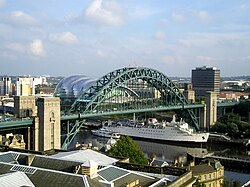
The Tyne Bridge is a through arch bridge over the River Tyne in North East England, linking Newcastle upon Tyne and Gateshead. The bridge was designed by the engineering firm Mott, Hay and Anderson, who later designed the Forth Road Bridge, and was built by Dorman Long and Co. of Middlesbrough. The bridge was officially opened on 10 October 1928 by King George V and has since become a defining symbol of Tyneside. It is ranked as the tenth tallest structure in Newcastle.