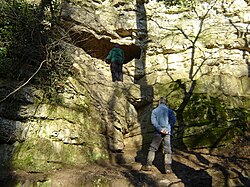
Welburn on Hodge Beck

Welburn is a village and civil parish in North Yorkshire, in England, 2 miles south-west of Kirkbymoorside and about 24 miles from York. The population of the parish was estimated at 60 in 2012. As the population of the civil parish was less than 100, it was not separately counted in the 2011 census and was included with the civil parish of Wombleton. The civil parish includes the lower part of Kirkdale, including Kirkdale Cave and the parish church of St Gregory's Minster, both about 0.6 miles (1 km) north of the village. The Slingsby Aviation works and airstrip lie south-east of the village. Welburn was historically a township in the parish of Kirkdale and became a civil parish in 1866. In 1870–72, John Marius Wilson's Imperial Gazetteer of England and Wales described Welburn like this:

"WELBURN, a township in Kirkdale parish, N. R. Yorkshire; 5 miles E of Helmsley. Acres, 1,582. Real property, £2,846. Pop., 121. Houses, 20." From 1974 to 2023, it was part of the district of Ryedale, it is now administered by the unitary North Yorkshire Council. The name Welburn derives from the Old English wellaburna meaning 'spring by a stream'.

Nearby Places View Menu
Location Image
557 m

Ryedale Show

The Ryedale Show is an agricultural show which takes place at the Welburn Park Showground, Welburn, Kirkbymoorside, North Yorkshire in the North of England annually on the last Tuesday of July. It is organised and run by the Ryedale Agricultural Society. In recent years the Ryedale Show has become the largest one-day agricultural show in the north of England. It features several agricultural show staples such as features of Equestrianism and competition between farmers as to the quality of Livestock.
Location Image
1.2 km

Kirkdale Cave

Kirkdale Cave is a cave and fossil site located in Kirkdale near Kirkbymoorside in the Vale of Pickering, North Yorkshire, England. It was discovered by workmen in 1821, and found to contain fossilized bones of a variety of mammals from the Eemian interglacial (globally known as the Last Interglacial, ~130-115,000 years ago), when temperatures were comparable to contemporary times, including animals currently absent from Britain or globally extinct, including hippopotamuses (amongst the farthest north any such remains have been found), straight-tusked elephants, the narrow-nosed rhinoceros, and cave hyenas. William Buckland analyzed the cave and its contents in December 1821 and determined that the bones were the remains of animals brought in by hyenas who used it for a den, and not a result of the Biblical flood floating corpses in from distant lands, as he had first thought. His reconstruction of an ancient ecosystem from detailed analysis of fossil evidence was admired at the time, and considered to be an example of how geo-historical research should be done. The cave was extended from its original length of 175 metres (574 ft) to 436 metres (1,430 ft) by Scarborough Caving Club in 1995. A survey was published in Descent magazine.
Location Image
1.3 km

Wombleton

Wombleton is a village and civil parish in North Yorkshire, England. It is situated just south from the main Thirsk to Scarborough road (A170) and 7 miles (11 km) to the west of Pickering.
Location Image
1.4 km

Kirkdale sundial

The ancient canonical sundial at St Gregory's Minster, Kirkdale in North Yorkshire, England, near Kirkbymoorside, dates to the mid 11th century. The panel containing the actual sundial above the church doors is flanked by two panels, bearing a rare inscription in Old English, the language of the Anglo-Saxons. The sundial, discovered during a renovation in 1771, commemorates the rebuilding of the ruined church, about the year 1055, by Orm, son of Gamal, whose Scandinavian names suggest that he may have been a descendant of Vikings who overran and settled this region in the late 9th century.