Location Image

Phare de Herd Groyne

Le phare de Herd Groyne est un phare de port situé sur un épi protègeant la jetée sud de l'entrée de la rivière Tyne à South Shields dans le comté du Tyne and Wear en Angleterre. Il est géré par les autorités portuaires de Port of Tyne (en) avec plusieurs autres phares du port.

Nearby Places View Menu
Location Image
415 m

River Tyne

The River Tyne is a river in North East England. Its length (excluding tributaries) is 73 miles (118 km). It is formed by the North Tyne and the South Tyne, which converge at Warden near Hexham in Northumberland at a place dubbed 'The Meeting of the Waters'. The Tyne Rivers Trust measure the whole Tyne catchment as 2,936 km2 (1,134 square miles), containing 4,399 km (2,733 miles) of waterways.
Location Image
499 m

Black Middens

The Black Middens is a reef at the mouth of the River Tyne in North East England, noted for the danger it poses to shipping.
Location Image
574 m

Tynemouth Lifeboat Station

Tynemouth Lifeboat Station is located overlooking the River Tyne at Fish Quay, North Shields, in the county of Tyne and Wear. A lifeboat was first stationed across the River Tyne in South Shields in 1789, with a second lifeboat placed in North Shields in 1798, both operated by the Tyne Lifeboat Institution (TLI). The Royal National Lifeboat Institution (RNLI) currently operates a Severn-class lifeboat 17-34 Osier (ON 1263), on station since 2021, and a D-class (IB1) Inshore lifeboat Little Susie (D-829), on station since 2018.
Location Image
579 m

North Shields Fish Quay

North Shields Fish Quay is a fishing port located close to the mouth of the River Tyne, in North Shields, Tyne and Wear, North East England, 8 miles (13 km) east of the city of Newcastle upon Tyne. The quay was established in 1225 as shielings village (seasonal huts used by hunters or fishermen) around the Pow Burn; the town of North Shields, where it takes its name from the shielings. The quay was originally located to serve the nearby Tynemouth Castle and Priory. The original site is largely derelict industrial land currently being redeveloped, which belonged to the original Tyne Brand canning company. The Pow Burn runs from nearby Northumberland Park and disappears underground at Tynemouth Road and the Metro urban transport line, eventually flowing into the Tyne. The development of North Shields was restricted due to the neighbouring port, Newcastle upon Tyne, which was the region's leading port at the time. Its trade guilds resented trade outside of the city, so that coal mined in North Shields within 300 ft (91.4 m) of the river had to be transported on land 8 miles to Newcastle to be loaded onto boats. In the 18th and 19th centuries, the North Shields Fish Quay High Light and Low Light lighthouses, which now are defunct, provided a line of sight for vessels entering from the river mouth. Before the north and south piers were built, many ships foundered on the rocks known as the Black Middens, which lie to the east of the quay and can be seen at low tide. The site has an original Old High Light and Old Low Light as well as High Light and Low Light, called so because they were positioned low (at river level on the quay) and high (on the bank top some 150 ft higher (46 m)). The present quay was built in 1870 to accommodate the increase in fishing boats after the introduction of steam trawlers. It is the largest English port for prawns. Its proximity to the Dogger Bank has led fishing boats from Whitby and elsewhere on the north east coast to relocate there. Adjacent shops include fish outlets and fish processing facilities, mainly of crab and prawn. The Fish Quay was once the biggest kipper producer in the UK, but the fall in herring stocks has reduced the trade to a single smokery. A number of traditional smokehouses still exist but have been converted to other uses, the area having been substantially repurposed to include residential accommodation, eateries and other entertainment facilities. However, although much reduced, a healthy seafood trade still exists with daily refrigerated lorry movements. Clifford's Fort, located on the Fish Quay, was built in 1672 as a coastal defence against the Dutch, and also played a role during the Napoleonic Wars. The fort was named after Lord Clifford, a member of King Charles II's Cabal. It is now a scheduled monument. The Fish Quay declined in the 1980s as a result of problems in the fishing industry. Refurbishment of the area was begun by Tyne and Wear Development Corporation and then beginning in 2001 based on a consultancy report. The Old Low Light building has been converted into a heritage centre, which opened in 2015.
Location Image
585 m

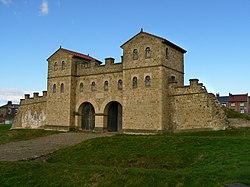
Arbeia

Arbeia was a large Roman fort in South Shields, Tyne & Wear, England, now ruined, and which has been partially reconstructed. It was first excavated in the 1870s. All modern buildings on the site were cleared in the 1970s. It is managed by North East Museums as Arbeia, South Shields Roman Fort.