

 English
 Français

Cathédrale de Durham
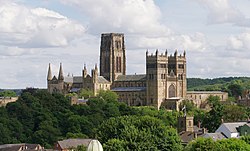
La cathédrale de Durham (en anglais : The Cathedral Church of Christ, Blessed Mary the Virgin and St Cuthbert of Durham, plus connue sous le nom de Durham Cathedral) est située dans la cité de Durham dans le comté de Durham, en Angleterre. Fondée en 1093, c'est le premier édifice anglais à avoir reçu des voûtes sur toutes ses parties, à être à la fois une abbatiale et une cathédrale, le siège d'un pèlerinage important aux reliques de saint Cuthbert et un point de défense de l'Angleterre face à l'Écosse. Elle est inscrite avec le château de Durham au Patrimoine mondial de l'UNESCO en 1986.
Nearby Places View Menu

51 m
Durham Priory
Durham Priory was a Benedictine priory associated with Durham Cathedral, in Durham in the north-east of England. Its head was the Prior of Durham. It was founded in 1083 as a Roman Catholic monastery, but after Dissolution of the Monasteries in 1540 the priory was dissolved and the cathedral was taken over by the Church of England.
71 m
Durham Cathedral
Durham Cathedral, formally the Cathedral Church of Christ, Blessed Mary the Virgin and St Cuthbert of Durham, is a Church of England cathedral in the city of Durham, England. The cathedral is the seat of the bishop of Durham and is the mother church of the diocese of Durham. It also contains the shrines of the Anglo-Saxon saints Cuthbert and Bede. There are daily Church of England services at the cathedral, and it received 393,090 visitors in 2024. It is a grade I listed building and forms part of the Durham Castle and Cathedral World Heritage Site.
The cathedral is the successor to the Anglo-Saxon Lindisfarne Priory, which was established c. 635 but abandoned in 875 in the face of Viking raids. The monks settled at Chester-le-Street from 882 until 995, when they moved to Durham. The cathedral remained a monastery until it was dissolved in 1541, since when it has been governed by a dean and chapter. The cathedral precinct formed part of Durham Castle from the eleventh century. During the Wars of the Three Kingdoms the cathedral housed 3,000 Scottish prisoners of war, 1,700 of whom died in the building.
A substantial part of the present building was completed between 1093 and 1133, replacing the Anglo-Saxon "White Church". It is a significant example of the Romanesque architectural style, and the nave ceiling is the earliest surviving example of a pointed rib vault. The Galilee chapel was added to the west end of the cathedral in the 1170s, and the western towers built in approximately 1200. The east end was expanded in the Early English Gothic style in the 1230s, and the Perpendicular Gothic central tower was built in two stages in the fifteenth century. Important furnishings include the medieval bishop's throne and Neville screen, Prior Castell's Clock, and the seventeenth-century choir stalls and font cover installed by Bishop Cosin. Many of the monastic buildings survive; the monks' refectory now contains part of the cathedral library, which holds significant collections dating back to the sixth century.

129 m
Palace Green
Palace Green is an open space in the centre of Durham, England, flanked by Durham Cathedral and Durham Castle. The Cathedral and Castle together form a UNESCO World Heritage Site.
Although initially not part of the site itself, Palace Green was added to the UNESCO site in 2008.
It is situated on top of the narrow, high peninsula formed by a sharp bend in the River Wear. The cathedral is on the southern side, facing the castle across the green on the north side. To the east are Durham University buildings including the law, theology, classics and history departments, with the music department and the university's special collections library to the west.
From the north and east Palace Green is accessed by two cobbled streets called Owengate (formerly Queen's Street) and Dun Cow Lane, the latter taking its name from a local legend involving a milkmaid and her cow. From the west a passageway, 'Windy Gap', leads down to the banks of the River Wear between two buildings which are now part of the university's music department. Early in the twentieth century one of the buildings was the home of the novelist J. Meade Falkner, author of Moonfleet.
In summer, Palace Green is sometimes used by students of Durham University as a croquet lawn with the permission from the groundsman of University College Durham.
'Palace Green' is also the name of a hymn tune written by Michael Fleming (1928–2006) while a music student at the university, used for the hymn 'Sing Praise to God Who Reigns Above'.

138 m
Cosin's Library
Bishop Cosin's Library, originally the Episcopal Library or Bibliotheca Episcopalis Dunelmensis, is an historic library founded in 1669 in Durham, England. Owned by the University of Durham, the library is open to the public.

148 m
New College, Durham (17th century)
New College, Durham, or Durham College, was a university institution set up by Oliver Cromwell, to provide an alternative to (and break the effective monopoly of) the older University of Oxford and University of Cambridge. It also had the aim of bringing university education to Northern England.
It was formed in 1653, receiving its letters patent – though not degree-awarding powers – in 1656, but after Cromwell's death in 1659 the universities of Oxford and Cambridge petitioned his son Richard Cromwell against the new university, and the college ceased to exist with the restoration of the monarchy in 1660.