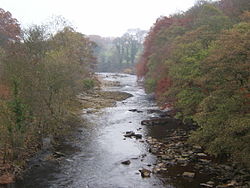
The River Swale in Yorkshire, England, is a major tributary of the River Ure, which becomes the River Ouse, that empties into the North Sea via the Humber Estuary. The river gives its name to Swaledale, the valley through which it flows. The river and its valley are home to many types of flora and fauna typical to the Yorkshire Dales. Like similar rivers in the region, the river carves through several types of rock and has features typical of both river and glacial erosion. The River Swale has been a contributory factor in the settlements that have been recorded throughout its history. It has provided water to aid in the raising of crops and livestock, but also in the various mining activities that have occurred since Roman times and before. The river is said to be the fastest flowing in England and its levels have been known to rise 10 feet (3 m) in 20 minutes. Annual rainfall figures average 1800 mm p.a. in the headwaters and 1300 mm p.a. in the lower waters over a drop of 148 m in 32 km.

Nearby Places View Menu
877 m

Battle of Myton

The Battle of Myton, nicknamed the Chapter of Myton or The White Battle because of the number of clergy involved, was a major engagement in the First Scottish War of Independence, fought in Yorkshire on 20 September 1319.
Location Image
949 m

Myton Bridge

Myton Bridge is a historic structure in Myton-on-Swale, a village in North Yorkshire, in England. A bridge over the River Swale in Myton was first recorded in the early 12th century, but it was demolished later in the century, and a replacement not built until 1313. It was a scene of fighting during the Battle of Myton, and had collapsed by 1354. In 1868, a new bridge was constructed at the same location, on the initiative of Henry Miles Stapylton. It has three arches, the central one, 100 feet (30 m) wide, for the river, and the others, each 24 feet (7.3 m) wide, for floodwater. The structure was designed by G. Gordon Page, under the supervision of his father, Thomas Page. The bridge was grade II listed in 1991, and was restored in 2002. The bridge is constructed cast iron, and consists of a shallow triple arch with openwork spandrels, and circular panels containing shields, each decorated with a lion in relief. There are iron cross-girders, and an octagonal patterned iron balustrade with a handrail. The abutments are in red brick with stone dressings and have corner piers, those on the river side with chamfered plinths, bracketed cornices and pyramidal caps. Outside them are brick parapet walls with stone coping on brackets, and at the end are shorter piers.
Location Image
993 m

Myton-on-Swale

Myton-on-Swale is a village and civil parish in North Yorkshire, England. It is about 3 miles (5 kilometres) east of Boroughbridge and on the River Swale.
Location Image
1.1 km

St Mary's Church, Myton-on-Swale

St Mary's Church is the parish church of Myton-on-Swale, a village in North Yorkshire, in England. The church was built in the early 13th century, and was altered in the 15th century, when some of the windows were replaced. The building was restored by C. Hodgson Fowler in 1886, when the tower and porch were added, and the roof was replaced. The church was grade II* listed in 1960. The church is built of sandstone and has a green tile roof with bands of red tile. The building consists of a nave, a north aisle, a south porch, a chancel, and a west tower embraced by the nave. The tower has three stages, a two-light west window, two-light bell openings, a clock face on the south side, and an embattled parapet. Inside, the furnishing date from 1886 or later, but there is the head of a 13th-century cross slab. The east window has stained glass designed by Charles Eamer Kempe.