


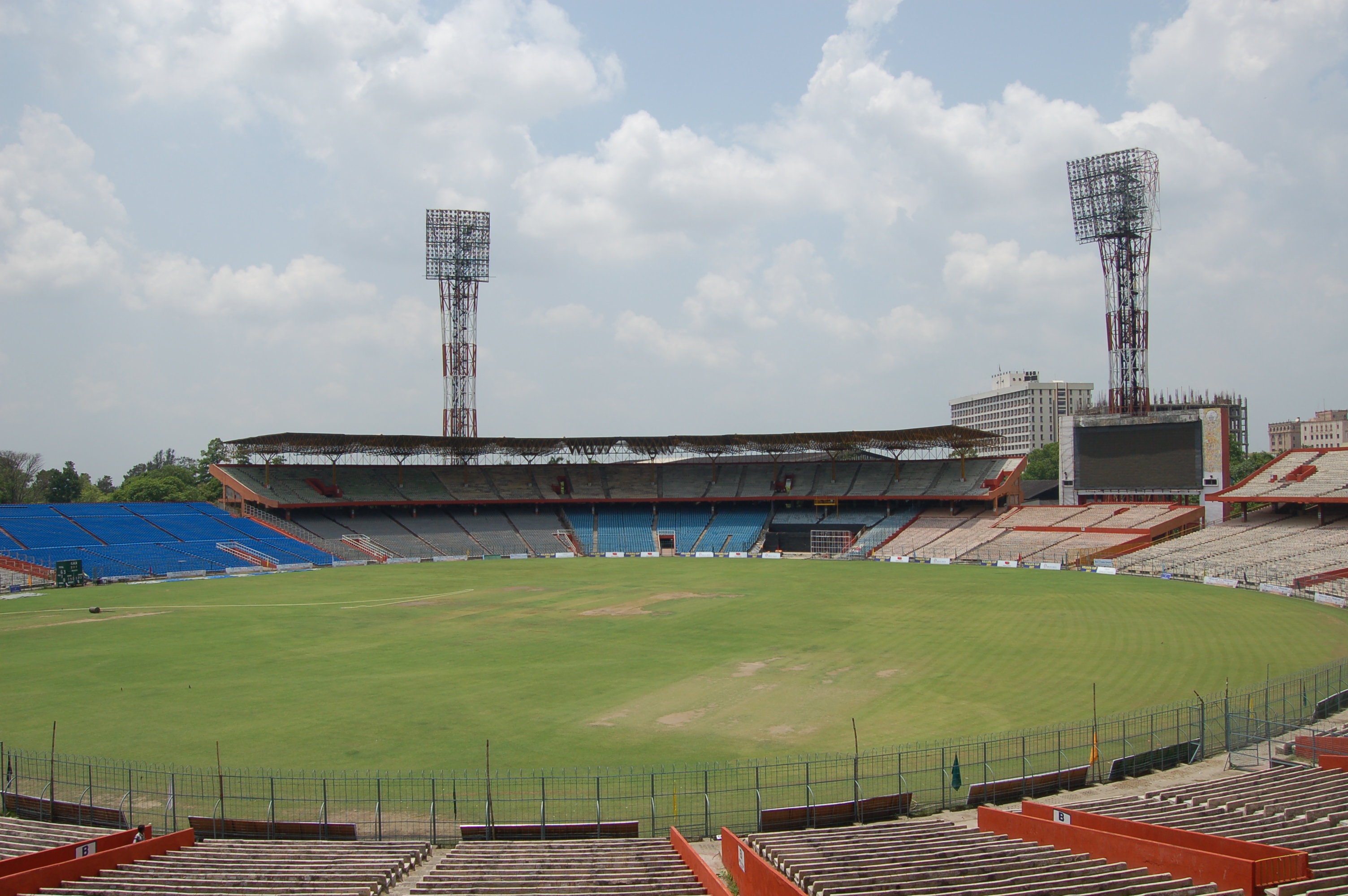
North-East Frontier Railway Stadium is a multi-purpose stadium at Maligaon in Guwahati, Assam. It is mainly used for organizing matches of football and cricket. The stadium has hosted 33 first-class matches in 1976 when Assam cricket team played against Orissa cricket team. The ground hosted 32 more first-class matches from 1978 to 2009.
Book your tour near
Northeast Frontier Railway Stadium
Book Now
4.2
in partnership with
GetYourGuide.com
Gallery

Sponsored
Location
1 explorer visited this place
0 m
Maligaon is a locality of Guwahati, Assam. The headquarters of Northeast Frontier Railway and Northeast Frontier Railway Stadium is situated there.

590 m
Kendriya Vidyalaya Maligaon is a higher secondary school located at the Maligaon area in Guwahati, Assam, India. It was established in 1979 and is affiliated with the Central Board of Secondary Education. The school provides education to the children of Central Government employees, especially railway employees, armed forces and paramilitary personnel. The school is run by KVS an autonomous body formed under the Ministry of Human Resource Development, Government of India and is affiliated to the Central Board of Secondary Education, New Delhi.
Kendriya Vidyalaya NFR Maligaon is a project school under the North East Frontier Railway and is close to the Kamakhya Railway Station. Its Secondary section building is constructed on seven acres. It has Computer Labs, a Physics lab, Chemistry Lab, Biology Lab, Geography Lab, Mathematics Lab, Biotechnology-cum-Junior Science Lab, Music Room, Art Education room, Work Education room and a Library. It has a separate Primary Building, sports complex, auditorium, and an assembly hall. It has a separate park for the Primary section students.

1.2 km
Atal Udyan is an urban park situated at Adabari Tiniali in the Maligaon area of Guwahati, India.
1.5 km
Maligaon Chariali is the focal -point of Maligaon, in Guwahati. It is located between Jalukbari Point and Kamakhya foot hill of famous Kamakhya Temple. The road passing through Maligaon earlier was called Assam Trunk Road and during ist tenure of AGP, the road has been christened as the Dinesh Goswami Road. The word ‘chariali’ in Assamese means ‘a place where four roads meet. Towards the west from Maligaon Chariali one finds the Dinesh Goswami road approaching Jalukbari via Adabari, while towards the east, one approaches Kamakhya foot hill. A few decades back Maligaon was not part of Guwahati but of Pandu; from 1975 Maligaon became part of Guwahati. The Padmanath Gohain Baruah Road runs from Maligaon Chariali to NH-37 at Tetelia via Maligaon Goshala. The fourth road is the one that originates at Maligaon Chariali and runs northwest towards Pandu Cabin, touching Aruna Cinema Hall and Pandu College on the way. The Jalukbari Police Station lies at this corner of the Chariali. A foot overbridge for pedestrians has been inaugurated in early 2013.
The Kamakhya Railway Junction leads from Maligaon Chariali. This Railway station earlier named as Jalukbari.

1.6 km
Kamakhya Temple is a Hindu temple at Nilachal hills in Guwahati, Assam is one of the oldest and most revered centres of Tantric practices, dedicated to the goddess Kamakhya. The temple is the center of the Kulachara Tantra Marga and the site of the Ambubachi Mela, an annual festival that celebrates the menstruation of the goddess. Structurally, the temple is dated to the 8th-9th century with many subsequent rebuildings—and the final hybrid architecture defines a local style called Nilachal. It is also one among the oldest 4 of the 51 pithas in the Shakta tradition. An obscure place of worship for much of history it became an important pilgrimage destination, especially for those from Bengal, in the 19th century during colonial rule.
Originally an autochthonous place of worship of a local goddess where the primary worship of the aniconic yoni set in natural stone continues till today, the Kamakya Temple became identified with the state power when the Mleccha dynasty of Kamarupa patronised it first, followed by the Palas, the Koch, and the Ahoms. The Kalika Purana, written during the Pala rule, connected Naraka, the legitimizing progenitor of the Kamarupa kings, with the goddess Kamakhya representing the region and the Kamarupa kingdom.
It has been suggested that historically the worship progressed in three phases—yoni under the Mlechhas, yogini under the Palas and the Mahavidyas under the Kochs. The main temple is surrounded in a complex of individual temples dedicated to the ten Mahavidyas of Saktism, namely, Kali, Tara, Tripura Sundari, Bhuvaneshwari, Bhairavi, Chhinnamasta, Dhumavati, Bagalamukhi, Matangi and Kamalatmika. Among these, Tripurasundari, Matangi and Kamala reside inside the main temple whereas the other seven reside in individual temples. Temples for individual Mahavidyas together as a group, as found in the complex, is rare and uncommon.
In July 2015, the Supreme Court of India transferred the administration of the Temple from the Kamakhya Debutter Board to the Bordeuri Samaj.
The stadium also hosted 18 List A matches when Central Zone cricket team played against North Zone cricket team but since then the stadium has hosted non-first-class matches.