

 English
 Français
SM UB-107
SM UB-107 was a German Type UB III submarine or U-boat in the German Imperial Navy (German: Kaiserliche Marine) during World War I. She was commissioned into the German Imperial Navy on 16 February 1918 as SM UB-107. The submarine conducted 4 patrols and sank 11 ships during the war for a total loss of 26,147 GRT. UB-107 was sunk on 27 July 1918 by HMS Vanessa and HMT Calvis at 54°23′N 0°24′W.
Nearby Places View Menu
3.9 km
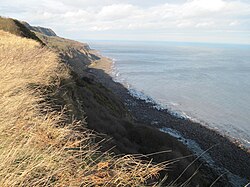
Beast Cliff
Beast Cliff is a steep sea cliff situated about halfway between Whitby and Scarborough on the coast of North Yorkshire in northeastern England. Beast Cliff is at the southern end of a coastal region designated as a Special Area of Conservation and Site of Special Scientific Interest. Bordering the eastern edge of the North York Moors national park, the Cleveland Way runs at the head of the cliffs.
In terms of its position on the Ordnance Survey National Grid system of geographical mapping, Beast Cliff is mostly in the one-kilometre grid square TA0099 but at its northern end it extends into OV. That point is the only area of land in the entire 100-kilometre national grid square of OV, adjoining NZ, SE and TA.

4.5 km
Hayburn Wyke railway station
Hayburn Wyke railway station was a railway station on the Scarborough & Whitby Railway, 7 miles from Scarborough. It opened on 16 July 1885, and served the popular local beauty spot of Hayburn Wyke, and the Hayburn Wyke Hotel. The platform was originally on the up side of the line, but was moved to the down side on request of the NER.
The station was rebuilt in 1893, and closed temporarily on 1 March 1917. Reopening took place on 2 May 1921 before final, permanent closure on 8 March 1965. From 1955 the station was reduced to an unstaffed halt. The former stationmaster's house dating back to 1892, which stands parallel to the former line, survives as a private residence.
The Cinder Track, a multi-user path used by walkers, cyclists and horse-riders, passes through the station on the line of the old railway, whilst the Cleveland Way lobg-distance footpath passes just to the east.

4.5 km
Staintondale railway station
Staintondale railway station was 8 miles (13 km) north of Scarborough and served the hamlet of Staintondale in North Yorkshire, England. It opened on 16 July 1885 when the Scarborough & Whitby Railway opened the full line. In 1937 the station was renamed as Stainton Dale (written as two separate words).
The station had two platforms either side of a passing loop and a small goods yard to the west. It was listed in 1904 as being able to handle general goods, livestock, horse boxes and prize cattle vans. There was no permanent crane, although one is shown on the 1893 Ordnance survey map. A camping coach was positioned here by the North Eastern Region from 1954 to 1958 and two coaches were here from 1959 to 1964.
On 4 May 1964 the goods service was withdrawn from the station, which closed completely on 8 March 1965. During the station's final year of operation its average weekly taking was £15 but the wages bill for the station came to £180.
The platforms and the main station buildings (used for residential purposes) are still in place. The railway alignment through the station is used by the Cinder Track, a multi-use path between Scarborough and Whitby.

4.9 km
Bent Rigg radar station
Bent Rigg Radar Station, also known as Royal Air Force Ravenscar, and Ravenscar tracking station, was a radar site located at Bent Rigg, 0.6 miles (1 km) south of Ravenscar, North Yorkshire, England. Several radar stations had been located in the Ravenscar area since 1938, but a more permanent site was built at Bent Rigg in 1941, which was crewed by technicians and other staff from the Royal Air Force. Bent Rigg and the wider location around Ravenscar were deemed "attractive" for the siting of long-range finding equipment. It was originally part of the Coastal Defence/Chain Home Low (CD/CHL) system, designed to detect shipping. Later, it was upgraded with more powerful equipment as part of the Chain Home Extra Low (CHEL). The last recorded use of the station was in September 1944, and it is believed that the site closed soon afterwards.
A few structures remain at the site, with the foundations of the accommodation blocks still extant near an abandoned railway line to the west. The site is open to the public, being located next to the Cleveland Way, and the National Trust has erected information boards detailing the buildings and the history of the site.