


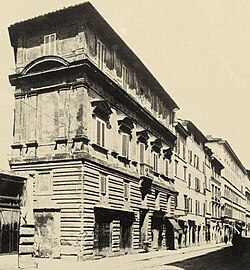
Le palais Jacopo da Brescia (en italien : Palazzo Jacopo da Brescia) était un palais de la Renaissance situé à Rome, en Italie, qui était situé dans le faubourg de Borgo.
Gallery

Sponsored
Location
14 m
Palazzo Jacopo da Brescia was a Renaissance palace in Rome, Italy, which was located in the Borgo rione.
It was built for Jacopo da Brescia, a physician at the service of Pope Leo X, between 1515 and 1519. Its design is commonly attributed to Raphael, and was based to Bramante's nearby Palazzo Caprini. The palace, which had a triangular footprint, stood at the confluence of the Borgo Nuovo and the Borgo Sant'Angelo. On the Borgo Nuovo, the house bordered to the east the house of Febo Brigotti, doctor to Pope Paul III, another notable Renaissance building. It was demolished to allow the construction of Via della Conciliazione in 1937, and rebuilt along Via Rusticucci and Via dei Corridori, not far from its original location.

25 m
The House di Febo Brigotti is a Renaissance house located on Via dei Corridori 44, in the Borgo rione of Rome.

25 m
The Leonine City is the part of the city of Rome which, during the Middle Ages, was enclosed with the Leonine Wall, built by order of Pope Leo IV in the 9th century.
This area was located on the opposite side of the Tiber from the seven hills of Rome, and had not been enclosed within the ancient city's Aurelian Walls, built between 271 and 275. After Christianity had risen to prominence and the Western Roman Empire had collapsed, the area had to be defended through the construction of a new wall, since it housed St. Peter's Basilica.
Today the territory of the former Leonine City consists of the Vatican City State and the Roman rione of Borgo.

47 m
The Palazzo Rusticucci-Accoramboni is a reconstructed late Renaissance palace in Rome. Erected by the will of Cardinal Girolamo Rusticucci, it was designed by Domenico Fontana and Carlo Maderno joining together several buildings already existing. Due to that, the building was not considered a good example of architecture. Originally lying along the north side of the Borgo Nuovo street, after 1667 the building faced the north side of the large new square located west of the new Saint Peter's Square, designed in those years by Gian Lorenzo Bernini. The square, named Piazza Rusticucci after the palace, was demolished in 1937–40 because of the erection of the new Via della Conciliazione. In 1940 the palace was dismantled and rebuilt with a different footprint along the north side of the new avenue, constructed between 1936 and 1950, which links St Peter's Basilica and the Vatican City to the center of Rome.
90 m
The Prefecture for the Economic Affairs of the Holy See was a dicastery of the Roman Curia, erected on 15 August 1967, and entrusted with overseeing all the offices of the Holy See that managed finances, regardless of their degree of autonomy.
On 30 December 2016, the Prefecture was abolished by Pope Francis, in view of the reforms made by Fidelis dispensator et prudens.