

 English
 Français
Cowden Park House
Cowden Park House is a house in Alloa, Clackmannanshire, Scotland. On 17 June 1977 it was listed as a Category C(s) historic building. It was built in the 1850s for Alexander Forrester-Paton, a member of the family that owned the Patons and Baldwins wool company and large areas of land in Clackmannanshire. The architect was John Melvin Sr. (1805 – 7 March 1884).
Nearby Places View Menu
708 m
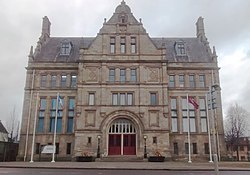
Alloa Town Hall
Alloa Town Hall is a municipal building in Marshill, Alloa, Scotland. The structure, which was the meeting place of Alloa Burgh Council, is a Category C listed building.
719 m
Alloa goods station (Caledonian Railway)
Alloa goods station was a goods railway station operated by the Caledonian Railway in Alloa, Clackmannanshire, Scotland, from 1885 to 1980.
The station was the planned terminus of the Alloa Railway as authorised by Parliament in 1884 when the Caledonian Railway absorbed the Alloa Railway. The station opened on 1 October 1885, when the complete line from Dunmore Junction on the South Alloa branch opened. The station was located on the western side of Glasshouse Loan to the north of Craigward Cooperage.
Passenger traffic on this line used the main Alloa station over a North British Railway connecting line.
The station closed in 1980, most of the site now making up a bus depot.

781 m
St Mungo's Parish Church
The church is named after Saint Mungo (also known as Saint Kentigern), patron saint and founder of the city of Glasgow. It belongs to the Church of Scotland Presbytery of Stirling and serves the parish of Alloa. A chapel dedicated to St Mungo is thought to have been erected during the fourteenth or fifteenth-century, which became dependent upon the Parish of Tullibody. Alloa had grown into a parish in its own right by 1600 when the Act of Assembly united the two parishes. In 1680, the original chapel was rebuilt and enlarged. The current church replaces the old parish church from the seventeenth-century which had been deemed much too small for the congregation for over seventy years and was declared ruinous and unsafe in August 1815. The condition of the old church was so bad that services were often being held in the open air rather than risking injury to the congregation The decision was finally made to abandon the old building and find a site for a new parish church. The Erskine family donated land at Bedford Place and work on the new St Mungo's church began in 1817. The church congregation temporarily worshipped in the Tabernacle until the completion in 1819 of the new church. Since land was judged at the time to have too great a value to the living to be set aside for the dead, no graveyard was planned or added to the new church. The more elaborate scale and design of the new building was intended to reflect the increased size and prosperity of the nineteenth-century congregation. The church was one of the largest in Scotland at the time it was built.

841 m
Northern Glass Cone, Alloa Glass Works
The Northern Glass Cone is a 19th-century glass cone formerly used in the glass manufacturing process at Alloa Glass Works in the burgh of Alloa, the administrative centre of the central Scottish council area of Clackmannanshire. The brick-built cone is the only such structure to survive in Scotland, and is one of four in the United Kingdom: the other three are at Lemington on Tyneside, Catcliffe in South Yorkshire and Wordsley in the West Midlands. It is a Scheduled Ancient Monument.