

 English
 Français
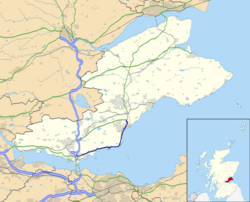
A921 road
The A921 road is a coastal road between the A92 in Kirkcaldy and Rosyth, the A985 and the M90 in Fife, Scotland. Before 1990, the road was classed as the A92. It passes through the towns and villages of Inverkeithing, Dalgety Bay, Aberdour, Burntisland, Kinghorn and Kirkcaldy. It previously went through the village of Hillend but it was bypassed in 1993.
Nearby Places View Menu
261 m
Battle of Raith
The Battle of Raith was the theory of E. W. B. Nicholson, librarian at the Bodleian Library, Oxford. He was aware of the poem Y Gododdin in the Book of Aneirin and was aware that no-one had identified the location "Catraeth". He parsed the name as "cat" Gaelic for battle or fight, and "Raeth" and he recalled that there was a place in Scotland called Raith.
Nicholson's claim was that this battle was fought in 596 AD to the west of present-day Kirkcaldy. An invading force of Angles landed on the Fife coast near Raith and defeated an alliance of Scots, Britons and Picts under King Áedán mac Gabráin of Dál Riata.
Today the location of the Battle of Catraeth is usually recognised instead as Catterick.
Nicholson's proposition was given added circulation when it was included in the local history book "Kirkcaldy Burgh and Schyre" by its editor and co-author Lachlan Macbean.

1.6 km
Kirkcaldy railway station
Kirkcaldy railway station is a railway station in the town of Kirkcaldy, Fife, Scotland. The station is managed by ScotRail and is on the Fife Circle Line and principal East Coast Main Line, 26 miles (42 km) north east of Edinburgh Waverley. British Transport Police maintain a small office on Platform 1.
The station is located on Station Road, with an entrance on Whyte Melville Road. There are car parks on either side with an extension on the Whyte Melville Road side for Edinburgh commuter traffic. The station building is situated on the Edinburgh platform. In the building is a ticket office (at street level), toilets, public phone, photo booth and shop.
Platforms are adjoined by a connecting subway and a flight of stairs. Two lifts have recently been installed for north and south platform access.
There are waiting rooms on both platforms and CCTV is in operation. Train running information is provided via CIS displays, automatic announcements and customer help points.
There are three main railway station bus stops located on Bennochy Road (off Station Road) with access to the car park. A further two bus stops are located on Whyte Melville Road, one of which is adjacent to the entrance and the other opposite University of Dundee Nursing Kirkcaldy Campus.

1.6 km
Kirkcaldy Galleries
Kirkcaldy Galleries is the main museum, library and exhibition space in Kirkcaldy in Fife, Scotland.

1.7 km
Kirkcaldy
Kirkcaldy ( kur-KAW-dee; Scots: Kirkcaldy; Scottish Gaelic: Cair Chaladain) is a town and former royal burgh in Fife, on the east coast of Scotland. It is about 11+1⁄2 miles (19 kilometres) north of Edinburgh and 27+1⁄2 mi (44 km) south-southwest of Dundee. The town had a recorded population of 49,460 in 2011, making it Fife's second-largest settlement and the 11th most populous settlement in Scotland.
Kirkcaldy has long been nicknamed the Lang Toun (; Scots for "long town") in reference to the early town's 0.9-mile (1.4 km) main street, as indicated on maps from the 16th and 17th centuries. The street would finally reach a length of nearly four miles (six kilometres), connecting the burgh to the neighbouring settlements of Linktown, Pathhead, Sinclairtown and Gallatown, which became part of the town in 1876. The formerly separate burgh of Dysart was also later absorbed into Kirkcaldy in 1930 under an act of Parliament.
The area around Kirkcaldy has been inhabited since the Bronze Age. The first document to refer to the town is from 1075, when Malcolm III granted the settlement to the church of Dunfermline. David I later gave the burgh to Dunfermline Abbey, which had succeeded the church: a status which was officially recognised by Robert I in 1327. The town only gained its independence from Abbey rule when it was created a royal burgh by Charles I in 1644.
From the early 16th century, the establishment of a harbour at the East Burn confirmed the town's early role as an important trading port. The town also began to develop around the salt, coal mining and nail making industries. The production of linen which followed in 1672 was later instrumental in the introduction of floorcloth in 1847 by linen manufacturer, Michael Nairn. In 1877 this in turn contributed to linoleum, which became the town's most successful industry: Kirkcaldy was a world producer until well into the mid-1960s. The town expanded considerably in the 1950s and 1960s, though the decline of the linoleum industry and other manufacturing restricted its growth thereafter.
Today, the town is a major service centre for the central Fife area. Public facilities include a main leisure centre, theatre, museum and art gallery, three public parks and an ice rink. Kirkcaldy is also known as the birthplace of social philosopher and economist Adam Smith who wrote his magnum opus The Wealth of Nations in the town. In the early 21st century, employment is dominated by the service sector: the biggest employer in the town is PayWizard, formerly known as MGT plc (call centre). Other main employers include NHS Fife, Forbo (linoleum and vinyl floor coverings), Fife College, Whitworths (flour millers) and Smith Anderson (paper making).