


The Mill Brook Bridge is a historic stone arch bridge, located just North of Lower Blissville Road in Lisbon, Connecticut. With a plausibly estimated construction date of the 1790s, it is probably the oldest surviving stone arch bridge in the state. It was listed on the National Register of Historic Places in 1997.
Location
1 explorer visited this place

564 m
Taft Tunnel is a railroad tunnel in the northeast United States, located in the southwest part of Lisbon, Connecticut. Completed in 1837, it was the first common carrier railroad tunnel built in the United States, though it was not used until 1839. It is still in use in its original form.

1.3 km
Taftville is a small village in eastern Connecticut, United States. It is a neighborhood of Norwich but has its own post office. It was established in 1866 as site for the large Taftville Mill, later Ponemah Mill. The village is listed on the National Register of Historic Places as Taftville and as alternative name Taftville/Ponemah Mill National Register Historic District.
Currently redevelopment of the large mill is being conducted by The O'Neill Group in conjunction with OneKey LLC. The National Park Service will oversee the historic preservation of the structure, to ensure the historic elements are sustained. The 430,000-square-foot Ponemah Mill is being converted into luxury apartments and commercial space.
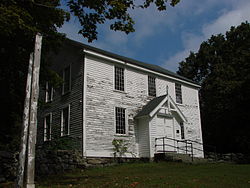
2.7 km
The Long Society Meetinghouse is a historic church building at 45 Long Society Road in Preston, Connecticut. It is one of only about a dozen surviving colonial "broad side" meeting houses, and is the last example surviving in Connecticut that has not been altered from that configuration by the addition of a tower or relocation of its entrance or pulpit. The meeting house was built from 1817 to 1819 on the site of an earlier meetinghouse, incorporating some elements of the earlier building. The meeting house was used both as a church and for civic functions, the reason for its plain, not overtly religious appearance. The building was added to the National Register of Historic Places in 1976.
3.0 km
WICH is a commercial radio station licensed to Norwich, Connecticut, and serving New London County. It is owned by Bonnie Rowbotham with the license held by Hall Communications, Inc. The station's studios and offices are located on Cuprak Road in Norwich. WICH airs a mix of soft oldies, adult standards and talk radio. It airs the syndicated "America's Best Music" radio format nights and weekends, with local DJs on weekday mornings and the talk show Fox Across America with Jimmy Failla on weekday afternoons.
WICH is powered at 5,000 watts, to avoid interfering with other stations on 1310 AM,it uses a directional antenna with a three-tower array. The station's transmitter is located on Tower Hill Road in Norwich. Programming is also heard on FM translator W233DB at 94.5 MHz.

3.0 km
Greeneville is a neighborhood of the city of Norwich, Connecticut, United States, located northeast of Downtown Norwich along the West Bank of the Shetucket River. Most of the neighborhood is designated Greeneville Historic District, a historic district that is listed on the National Register of Historic Places.
The district was listed on the National Register in 2005 and includes 683 contributing buildings, seven other contributing structures, and one other contributing site over a 300 acres area.
The district is drawn to "correspond to the village as it was laid out in 1833, but also include additional streets laid out and developed in the late nineteenth and early twentieth centuries to accommodate population growth. Areas north and south of the district boundaries were excluded...." as those areas included undeveloped land, or fewer contributing relative to non-contributing buildings, or reflected a "shift in architectural character."
According to the Connecticut Trust for Historic Preservation the district "is a historically significant industrial village that was created to support and sustain water-powered industry from 1828 to about 1940. Much of the enduring success of this industrial enterprise can be attributed to the entrepreneurial vision of industrialist William P. Greene. His development of this planned community and a company to deliver a centralized power system, combined with significant technological infrastructure improvements in the late 19th century, supported the largest industrial presence in Norwich. Although nominally a part of the City of Norwich after 1875, from its creation in 1833 until after World War I Greeneville remained a relatively independent and self-sufficient, working-class community-an evolution fully expressed by the district's large, cohesive collection of generally well-preserved domestic, institutional and commercial architecture. While much of the architecture has the vernacular character expected in a mill town, the district also includes representative examples of the major styles of the period, including Greek Revival, Second Empire, Italianate, and Carpenter Gothic."
Since then, it has deteriorated and is partially collapsed.
Book your tour near
Mill Brook Bridge
Book Now
4.0
in partnership with
GetYourGuide.com