


Vieillevie (French pronunciation: [vjɛjvi]; Occitan: Vièlhaviá) is a commune in the department of Cantal in south-central France. The village stands on the north (right) bank of the River Lot, approximately 12 km west of Entraygues. The river here is the boundary between the departments of Cantal and Aveyron, and a bridge takes you from the village into Aveyron.
Location
1 explorer visited this place

182 m
The Château de Vieillevie is a mediaeval castle in the commune of Vieillevie in the Cantal département of France. The castle is located in the centre of the village on a small rocky hill next to the Mairie.
The original construction dates from the 11th century, with modifications in the 15th and 16th centuries. It consists of a rectangular main building - the corps de logis - with, on the north, a short wing set back on the eastern side. On the south west and north west corners are circular towers. Unusually, the castle still has its wooden hoarding and machicolations. Inside, four beautiful 13th century monumental chimney places have been preserved. The rooms have ceilings covered in beams.
It has been listed since 1993 as a monument historique by the French Ministry of Culture. The castle is open to visitors on certain days in the summer months, with candlelit tours some evenings.

5.0 km
Grand-Vabre is a former commune in the Aveyron department in southern France. On 1 January 2016, it was merged into the new commune of Conques-en-Rouergue.

5.3 km
The Dourdou de Conques is an 83.7 km long river in the department of Aveyron, southern France. Its source is near the village of Lassouts. It flows generally west. It is a left tributary of the Lot, into which it flows near Grand-Vabre.

5.4 km
Conques is a former commune in the Aveyron department in Southern France, in the Occitania region. On 1 January 2016, it was merged into the new commune of Conques-en-Rouergue.
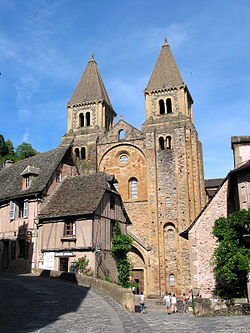
5.5 km
The Abbey Church of Sainte-Foy in Conques, France, was a popular stop for pilgrims traveling the Way of St. James to Santiago de Compostela, in what is now Spain. The main draw for medieval pilgrims at Conques were the remains of Sainte Foy, a young woman martyred during the fourth century. The relics of Sainte-Foy arrived in Conques through theft in 866. After unsuccessful attempts to acquire the relics of Saint Vincent of Saragossa and then the relics of St. Vincent Pompejac in Agen, the abbey authorities set their sights on the relics of Sainte-Foy at the ancient St. Faith's Church, Sélestat. The Conques abbey opened a priory next to the shrine in Sélestat. A monk from Conques posed as a loyal monk in Agen for nearly a decade in order to get close enough to the relics to steal them.
Beginning in the 13th century, the abbey began to fall into decline as Saint Faith's popularity was elipsed by that of other saints and due to Conques' marginal location. The abbey was confiscated from the Benedictine order in 1537 by order of the Bishop of Rodez, Georges d'Armagnac, and given to a chapter of regular cannons. In 1568, during the Wars of Religion, the Protestants seized Conques and burnt down much of the abbey, including parts of the church, most notably the original towers. The abbey experienced a brief revival in the 17th century, however, further destruction occurred due to the Revolution and the subsequent banishment of the cannons, resulting in quarrying the buildings by the then-impoverished villagers. Thanks to the work of individuals such as Prosper Mérimée and Étienne Boissonnade, the building was saved, restored, and returned to the Premonstratensians who sent monks from Mondaye Abbey. Today, the church remains a functional parish and pilgrimage church while also hosting choral and organ services.
The abbey church has been classified as a national monument of France since 1840.
The village is 32 km south of the large town of Aurillac and 35 km north of the large town of Rodez. In the village are a castle, a church, a hotel with an excellent restaurant (Hotel de la Terrasse), and a shop/cafe which offers many services.