

 English
 Français
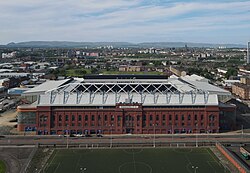
Ibrox Stadium
Ibrox Stadium, appelé à l'origine Ibrox Park, est un stade de football situé à Glasgow, dans le quartier d'Ibrox, sur la rive sud de la Clyde. Le club des Glasgow Rangers y réside depuis 1899.
Nearby Places View Menu
18 m
Ibrox Stadium
Ibrox Stadium is a football stadium on the south side of the River Clyde in the Ibrox area of Glasgow, Scotland. The home of Scottish Premiership team Rangers, Ibrox is the third-largest football stadium in Scotland, with an all-seated capacity of 51,700. The stadium was designed by renowned football stadium architect Archibald Leitch, with renovations to the stadium between 1978 and 1981, as well as 1990 and 1991, being designed by The Miller Partnership and Gareth Hutchison respectively.
Opened as Ibrox Park in 1899, it suffered a disaster in 1902 when a wooden terrace collapsed. Vast earthen terraces were built in its place, and a main stand, now a listed building, in 1928. A British record crowd of 118,567 gathered in January 1939 for a league match with Celtic. After another disaster in 1971, the stadium was largely rebuilt. The vast bowl-shaped terracing was removed and replaced by three rectangular, all-seated stands by 1981. After renovations were completed in 1997, the ground was renamed Ibrox Stadium.
A UEFA category four stadium, Ibrox hosted the Scotland national team when Hampden Park was redeveloped in the 1990s, and three Scottish cup finals in the same period, and has also been a concert venue. The stadium hosted the Rugby Sevens at the 2014 Commonwealth Games held in Scotland.

69 m
1902 Ibrox disaster
The 1902 Ibrox disaster was the collapse of a stand at Ibrox Park (now Ibrox Stadium) in Govan (now part of Glasgow), Scotland. The collapse caused the deaths of 25 supporters, and injuries to 500 more during an international association football match between Scotland and England on 5 April 1902 as part of the 1901–02 British Home Championship.
Ibrox Park had completed construction less than three years before the incident and was hosting its first international fixture, with the crowd estimated to be over 68,000. The match was the first time that the ground had been used at more than half capacity since its opening. Scotland entered the game needing only to avoid defeat to win the British Home Championship title. During the first half of the match, a section of the newly built West Tribune Stand collapsed, dropping between 200 and 300 people to the concrete floor below. Two spectators were declared dead at the scene, and a further twenty-three died of injuries sustained in the incident soon after, the last victim dying three weeks later.
Despite the collapse, the match was eventually resumed after a break as officials feared emptying crowds could interfere with rescue attempts and lead to further panic. The teams resumed the match, which ended in a 1–1 draw, although both the Scottish Football Association and the Football Association later agreed that the result should be voided. A replay was hastily organised and played a month later at Villa Park in Birmingham with all proceeds from the match being donated to a relief fund for victims of the disaster. The disaster led to an overhaul in stadium design, with wooden terraced stands being largely replaced by earth or concrete embankments.

151 m
1971 Ibrox disaster
The 1971 Ibrox disaster, also known as the Second Ibrox Disaster, was a crush among the crowd at an Old Firm football game (Rangers v Celtic), which led to 66 deaths and more than 200 injuries. It happened on 2 January 1971 on an exit stairway at Ibrox Park (now Ibrox Stadium) in Glasgow, Scotland. It was the worst football disaster in Britain until the Hillsborough disaster in Sheffield, England, in 1989.
The stadium's owner, Rangers FC, was later ruled to be at fault in a sheriff's judgement on one of the deaths. Rangers did not dispute this ruling and was sued for damages in 60 other cases brought by relatives of the dead.
154 m
Ibrox Park (1887–1899)
Ibrox Park was a football ground in Ibrox, Scotland. It was the home ground of Rangers from 1887 until they moved to the adjacent second Ibrox in 1899. The ground staged the Scottish Cup Final four times and also three Scotland international matches.

155 m
Ibrox, Glasgow
Ibrox () is a suburb of Glasgow, Scotland. It is situated south of the River Clyde and is part of the former burgh of Govan. The origin of the name Ibrox is unclear. It is often said to come from the Gaelic àth bruic, meaning "badger ford", but this is unconfirmed.
It is within walking distance of the Pacific Quay Media Park, housing BBC Scotland, STV and other production companies along with the Glasgow Science Centre. The opening of the Clyde Arc provides a road connection to the other side of the River Clyde. Ibrox is served by Ibrox subway station of the Glasgow Subway system.
The home of football club Rangers F.C. is located at Ibrox Stadium.
Ibrox Primary School is a primary school located on Edmiston Drive, the main road through Ibrox, directly across from Ibrox Stadium. The building was designed by Bruce and Hay and was opened in 1906. The school was originally known as Ibrox Board School, was built for the Govan Parish School Board.
Ibrox is home to an original artwork by South African artist Faith47. Located on Copland Road opposite the entrance to Fairley Street, the piece was completed during the preparations for the 2014 Commonwealth Games.