


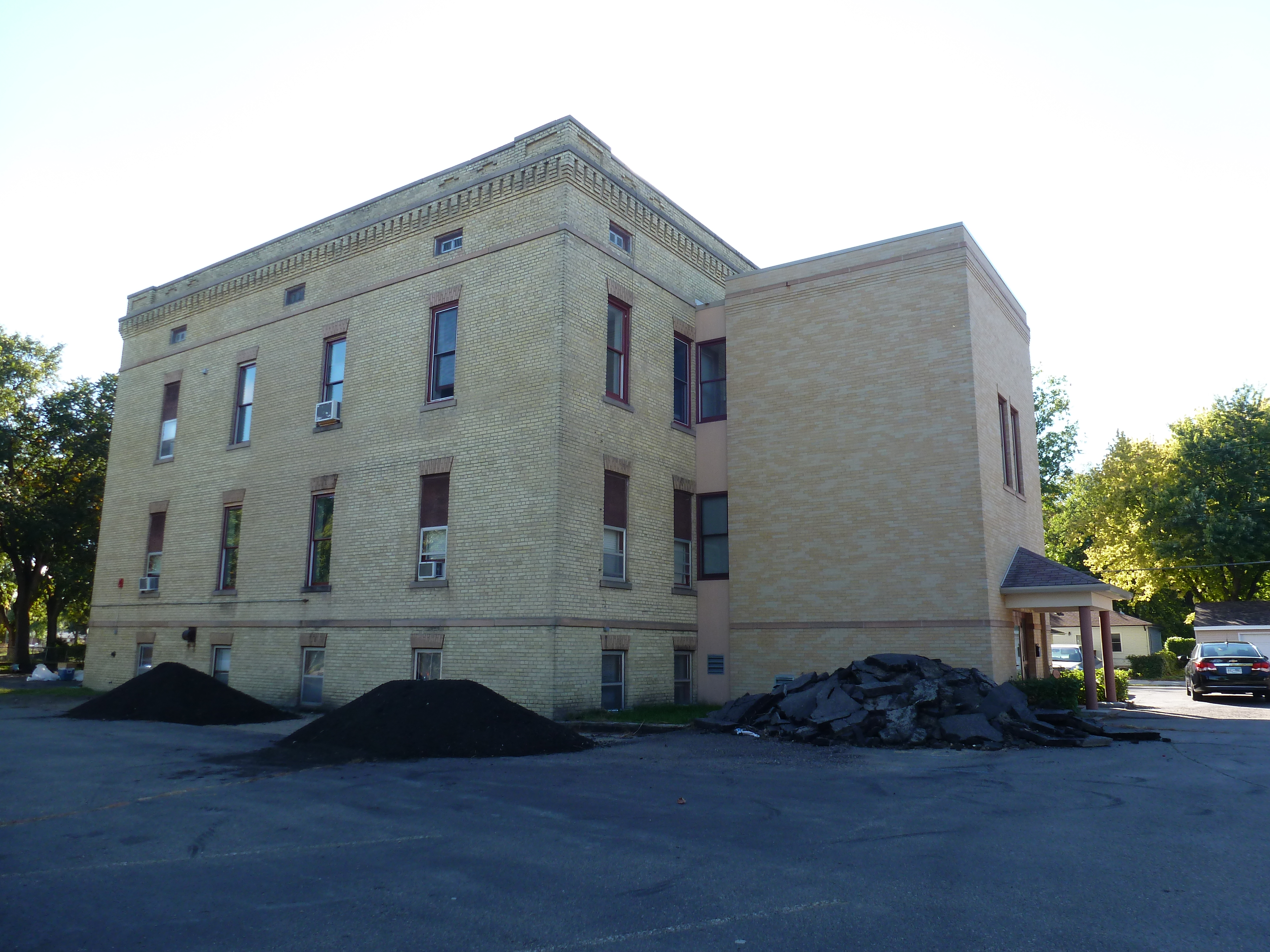
Fargo City Detention Hospital is a building in Fargo, North Dakota, United States, that was built in 1910. The hospital was designed as a place to sequester people afflicted with contagious disease. It's a two-story brick and tile building, designed by Frank Anders and built principally by C.H. Johnson. It had coal storage capacity of 40 tons.
Gallery

Sponsored
Location

200 m
The Fargo–Moorhead Toll Bridge is a former toll bridge on the Red River of the North between Fargo, North Dakota and Moorhead, Minnesota. It connects Moorhead's 15th Avenue N with Fargo's 12th Avenue N.
The bridge was to be privately operated until June 1, 2018, following a five-year extension of its original 25-year charter in 2013. In May 2014, The City of Moorhead sued Bridge Co., the owners of the bridge; and the city of Fargo. Judge Frank Racek ruled in favor of the city of Moorhead and that the ownership of the bridge would be transferred to the two cities.
Prior to the 2014 ownership transfer, the bridge had a toll of $0.75.
652 m
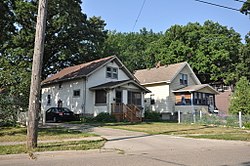
The Fargo Oak Grove Residential Historic District is a historic district located around North and South Terrace Avenues near downtown Fargo, North Dakota. The homes date from the period 1895 to 1955 and include working-class, gable-fronted cottages and vernacular bungalows." The district was listed on the National Register of Historic Places in 2011.
According to the State Historical Society of North Dakota, the district "has a tangible cohesiveness in the scale, density, material character, and landscape treatment that unifies this neighborhood."
Most of the Oak Grove neighborhood was flooded with several feet of water from the Red River in the spring of 1997. The area was flooded again in the spring of 2009.

684 m
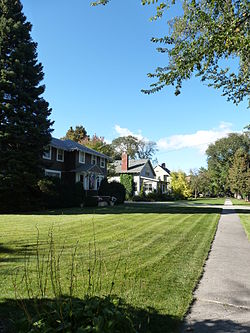
The North Side Fargo Builder's Residential Historic District is a 25.4-acre historic district with 103 contributing buildings located eight blocks north of downtown Fargo, North Dakota. The district's name derives from the fact that the plans for the houses came from popular builder's pattern books. The homes were built in the late 1920s and 1930s. Tudor Revival is the predominant style, though Colonial Revival and American Foursquare architecture is also present. The district was listed on the National Register of Historic Places in 1987.
767 m
The North Side Fargo High Style Residential Historic District in Fargo, North Dakota has significance dating back to 1894. It is a 11.7-acre historic district with 33 contributing buildings. It includes Colonial Revival, American Foursquare, and other architecture. It was listed on the National Register of Historic Places in 1987.

774 m
Oak Grove Lutheran School is a private, Lutheran school for students in pre-Kindergarten through grade 12 in Fargo, North Dakota. It was founded in 1906. Oak Grove began as school that housed mostly Norwegian schoolgirls.
It was listed on the National Register of Historic Places in 1987.