

 English
 Français

Cross Hills
Cross Hills is a village in the county of North Yorkshire, England, situated halfway between Skipton and Keighley. The village is at the centre of a built-up area that includes the adjoining settlements of Glusburn, Kildwick, Eastburn and Sutton-in-Craven. Cross Hills is the newer part of the civil parish now called Glusburn and Cross Hills, historically known as Glusburn. Until 1974 it was part of the West Riding of Yorkshire. From 1974 to 2023 it was part of the district of Craven, it is now administered by the unitary North Yorkshire Council.
Nearby Places View Menu
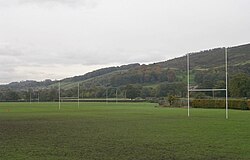
257 m
South Craven School
South Craven School is a coeducational secondary school and sixth form with academy status, located in Cross Hills, North Yorkshire, England. It is the largest school in the Craven District and carries over 1,700 pupils.
The school has formed partnerships with The Ogden Trust, Airedale NHS Trust a prominent employer in the local area, Craven College a local further education college and long-term partner Bradford University who work closely on STEM subjects (Science, Technology, Engineering and Mathematics) at the school, Leeds Trinity University, Leeds College of Music and finally the Bradford Local Authority.
South Craven School became an academy on 1 May 2011.

262 m
Kildwick and Crosshills railway station
Kildwick and Crosshills [sic] was a railway station off Station Road in Cross Hills, North Yorkshire (formerly West Riding of Yorkshire), England. It served the villages of Cross Hills, Cowling, Glusburn, Kildwick and Sutton-in-Craven.
796 m
Kildwick
Kildwick, or Kildwick-in-Craven, is a village and civil parish in the county of North Yorkshire, England. It is situated between Skipton and Keighley and had a population of 191 in 2001, rising slightly to 194 at the 2011 census. Kildwick is a landmark as where the major road from Keighley to Skipton crosses the River Aire. The village's amenities include a primary school, church and public house.
Until 1974 it was part of the West Riding of Yorkshire. From 1974 to 2023 it was part of the district of Craven, it is now administered by the unitary North Yorkshire Council.

804 m
Glusburn Institute
The Glusburn Institute is a historic building in Glusburn, a village in North Yorkshire, in England.
The building was commissioned by John Horsfall, who was a supporter of temperance and wished to encourage education and recreation in an alcohol-free environment. It was designed by F. W. Petty in a broadly Renaissance style, and the first section was opened in 1892. In 1897, an extension added a gym on the ground floor, and art rooms above, while the baths were extended in 1905, and a clock tower was added in 1911. On the ground floor were a library, reading room, billiard room, dining room and public baths; the first floor had a lecture room, also used for religious services, and smaller meeting rooms.
In 1948, the art rooms were converted into a Baptist chapel, and the gym into a Sunday school. In the 1970s, the Horsfall family transferred ownership of the building to a trust, with the local parish council acting as trustees. The church and Sunday school were sold to the Baptists, and partitioned off from the rest of the building. Later, the ground floor dining room and kitchen were converted into a play centre, and the swimming pool closed. The Baptist church closed in 2000, and the property was repurchased by the trust. In 2012, the parish council transferred trusteeship to the trust, which renamed the building as Glusburn Community and Arts Centre. The institute currently provides a range of classes, concerts, plays, and other activities. The building was grade II listed along with its garden wall in 1977.
The building is built of stone with a pierced arcaded parapet, turrets, and a green slate roof. There are two storeys and four irregular bays. On the left corner is an open turret with a stone cap and a ball finial, which is corbelled out above a panel with a florid achievement. The second bay forms a three-storey bay window, and the clock tower in the third bay has a stone dome and four domed pinnacles. Most of the windows are mullioned and transomed, and attached to the building is a low stone wall with domed piers and iron railings.