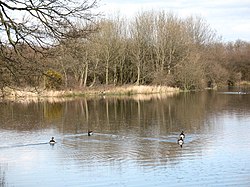
Ripon Parks is a Site of Special Scientific Interest, or SSSI, situated north of Ripon, to the west of the River Ure and to the east of the village of North Stainley, in North Yorkshire, England. It was once part of the land held since the Middle Ages as a deer park by the archbishops of York (including Cardinal Wolsey) and the canons of Ripon. The site was designated as an SSSI in 1983, because its varied habitats are valued for their breeding birds, amphibians and varied flora. The woods here are "of note" for the parasitic flowers of common toothwort and yellow star-of-Bethlehem. A small part of the site is accessible via public footpaths; there are no public facilities or dedicated car parks. The site incorporates the High Batts Nature Reserve, which is privately run for training, recording and educational purposes, and accessible to members only, except for its annual open day. Ripon Parks is now owned by the Ministry of Defence, and parts of the site are used as military training areas.

Nearby Places View Menu
Location Image
901 m

Middle Parks Farm

Middle Parks Farm is a farm near North Stainley, a village in North Yorkshire, in England. The farm lies on land which formed part of Ripon Park. The deer park had three hunting lodges, with Horseman's Lodge being the most important. It was built in about 1400, and extended in the 16th century, but was in ruins by 1649. That year, the park was enclosed to produce three farms, and Horseman's Lodge was converted into Middle Parks Farmhouse. The building was encased in brick in two stages, in the early 18th century and mid 19th century, and it was extended and altered in the 20th century. The farmhouse was grade II* listed in 1982. The farmhouse has a timber framed core, which has been encased in limestone and red brick, and has hipped Westmorland slate roofs. It has two storeys and an L-shaped plan, each range with three bays. The right end bay of the south front has quoins, the lower floor is in limestone and the upper floor in red brick. The lower floor contains a three-light mullioned window with round-headed lights, and on the upper floor is a three-light mullioned window, the lights with flat heads, and both with hood moulds. Elsewhere, the windows are sashes, and inside there is substantial remaining timber framing. One ground floor room has 17th-century plasterwork and a fireplace of similar date, and there is another 17th-century fireplace in the room above.
Location Image
1.2 km

Nunwick

Nunwick is a hamlet in the county of North Yorkshire, England. It is about 1 mile north-east of Ripon. Nunwick was historically a township in the ancient parish of Ripon in the West Riding of Yorkshire. The township included two detached parts (a house and a farm) at Howgrave in the parish of Kirklington in the North Riding of Yorkshire. The township, with its detached parts, became the civil parish of Nunwick cum Howgrave in 1866. Later in the 19th century the detached parts in the North Riding were transferred to the civil parishes of Howgrave and Sutton with Howgrave, although the parish name remained Nunwick cum Howgrave. In 1974 the parish was transferred to the new county of North Yorkshire. The population of the parish was only 31 in 1961, and in 1988 it was absorbed into the civil parish of Hutton Conyers. From 1974 to 2023 it was part of the Borough of Harrogate, it is now administered by the unitary North Yorkshire Council.
Location Image
1.3 km

North Lees

North Lees is a hamlet in the county of North Yorkshire, England. It is about 1.9 miles (3 km) north of Ripon on the A6108 road. The village is just south of Lightwater Valley and is served by a bus service four times a day between Ripon and Leyburn. From 1974 to 2023 it was part of the Borough of Harrogate, it is now administered by the unitary North Yorkshire Council. On the south eastern side of the village is the remains of a medieval moat and possibly the site of a Pele tower. Land towards the south western side was used as a firing range during the First World War. Other medieval (and possibly Roman) earthworks have been destroyed when the A6108 road was widened in the 20th century. On 5 July 2014, the Tour de France Stage 1 from Leeds to Harrogate passed through the village.
1.8 km

Norton Conyers

Norton Conyers is a civil parish in North Yorkshire, England, 3 miles (5 km) north of Ripon. There is no modern village in the parish. Most of the parish is occupied by the grounds of Norton Conyers House, which cover the site of a deserted medieval village. The population of the parish was estimated at 30 in 2015. Norton was mentioned in the Domesday Book in 1086, when the soke belonged to the Bishop of Durham. Between 1099 and 1133 Norton was enfeoffed to the Conyers family, and thus acquired its full name. When the Conyers estates were divided in 1199, Norton went to the elder branch of the family, along with Hutton Conyers. By the late 14th century the manor passed to the Norton family, one of whose members built Norton Conyers House. Norton Conyers was a chapelry of the parish of Wath in the North Riding of Yorkshire, although unlike the rest of the parish it formed part of the wapentake of Allertonshire. It became a separate civil parish in 1866. In 1974 it was transferred to the new county of North Yorkshire. From 1974 to 2023 it was part of the Borough of Harrogate, it is now administered by the unitary North Yorkshire Council.