


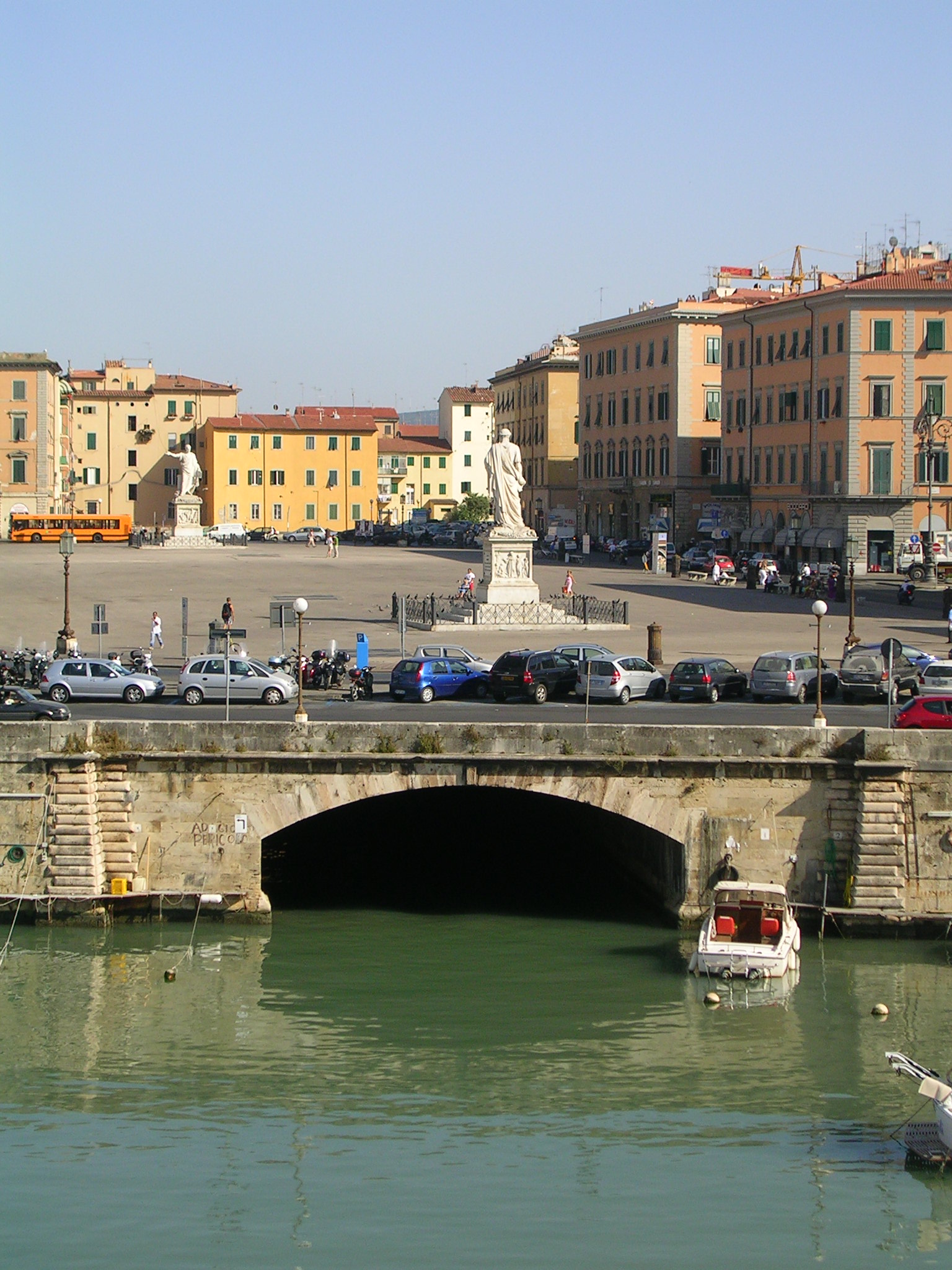
Le Fosso Reale de Livourne est une douve qui à l'origine suivait le périmètre de la ville fortifiée, par la suite, avec la destruction des bastions, elle a perdu sa fonction défensive. Le système des douves et canaux de Livourne a été proposé au patrimoine de l'humanité.
Gallery




Sponsored
Location

183 m
The province of Livorno or, traditionally, province of Leghorn, is a province in the Tuscany region of Italy. It includes several islands of the Tuscan Archipelago, including Elba and Capraia. Its capital is the city of Livorno. When formed in 1861, the province included only Livorno and Elba Island. It was extended in 1925 with land from the provinces of Pisa and Genoa. It has an area of 1,211 square kilometres and a total population of 343,003. The province contains 19 comuni. The coastline of the area is known as "Costa degli Etruschi".
The province of Livorno is coastal and contains a number of coastal towns. Livorno is a highly important port for tourism and trading, and a number of watchtowers are located nearby the city. At Calafuria, the sea contains sponges, shellfish, fish, and protected red coral. The coastlines of Quercianella and Castiglioncello are rocky. The waters around the province of Livorno sometimes contain dolphins. The town Marina di Bibbona was founded as a fort due to its strategic coastal position. Town San Vincenzo contains a fourteenth-century tower for strategic reasons. The sand of Golfo di Baratti is silver and black due to its high iron concentration, and the area contains an archaeological park.

183 m
Méditerranée was a department of the First French Empire in present-day Italy. It was named after the Mediterranean Sea. It was formed in 1808, when the Kingdom of Etruria was annexed directly to France. Its capital was Livorno.
The department was disbanded after the defeat of Napoleon in 1814. At the Congress of Vienna, the Grand Duchy of Tuscany was restored to its previous Habsburg-Lorraine prince, Ferdinand III. Its territory is now divided between the Italian provinces of Livorno, Pisa, Florence and Siena.

183 m
The Diocese of Livorno is a Latin diocese of the Catholic Church in Tuscany. It was created in 1806. It is a suffragan of the Archdiocese of Pisa. The current bishop is Simone Giusti.
Livorno was usually called Leghorn in English.

366 m
The Dutch German Church in Livorno, Italy, is on the stretch of the Fosso Reale canal that runs between Piazza della Repubblica and Piazza Cavour.
The Protestant church bears witness to the intercultural climate that once reigned in the city of Livorno. Since the second half of the 20th century, however, the church has been closed to the public and practically abandoned, and is now in need of major restoration work.
The risk of collapse to which the building is dangerously exposed was already reported in 2005 by the vice president of the consistory of the Congregation, Ennio Weatherford.

504 m
The former Caffè Bardi was a notable coffee house and meeting place in the 19th through mid-20th century for artists and intellectuals in Livorno, a region of Tuscany, Italy. The coffee-house no longer exists and stood at the corner of via Cairoli and Piazza Cavour.
In Florence, Caffè Michelangiolo had played a role as a meeting place for painter of the Macchiaioli movement; in Livorno, in the first decades of the twentieth century, this coffee house played the equivalent role of the development of a local group of painters known as the Gruppo Labronico.
Founded in 1908 by Ugo Bardi, the interiors of the coffee house were once populated by contemporary artworks, including works by Gino Romiti and Renato Natali since removed. One of the frequent early attendees was Amedeo Modigliani. There is a legend that Modigliani once brought one of his avant-garde sculptures to show to his friends, but their dislike caused him to bury them in a nearby ditch. The coffee house closed in 1921. Amedeo Modigliani probably attended the establishment during his trips to Livorno in 1909 and 1913.