Location Image

Roue de Falkirk

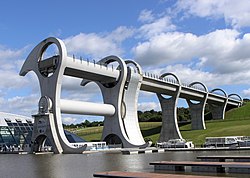
La roue de Falkirk, en anglais Falkirk Wheel, est un ascenseur à bateaux rotatif, reliant le Forth and Clyde Canal à l'Union Canal, près de la ville de Falkirk dans le centre de l'Écosse. L'ouverture de l'ascenseur en 2002 fait se rejoindre les deux canaux pour la première fois depuis les années 1930 dans le cadre du plan de Millennium Link. Le projet de remise en valeur des canaux de la Central Belt écossaise pour relier Glasgow à Édimbourg a été mené par British Waterways et soutenu et financé par sept représentants locaux des pouvoirs publics, par le réseau de la Scottish Enterprise (en) ainsi que le Fonds européen de développement régional et la Commission du Millénaire. Les chefs du projet ont décidé dès l'origine de faire de cette construction un édifice radicalement ancré dans le XXIe siècle plutôt que de recréer l'ancien escalier d'écluses. Le système d'ascenseur permet d'élever les bateaux de 24 m mais l'Union Canal est situé encore 11 m plus en hauteur ; les bateaux doivent donc franchir deux écluses pour le rejoindre. Cette « roue » est un modèle unique au monde, et constitue une œuvre remarquable d'ingénierie civile qui attire de nombreux touristes. Fonctionnant selon un principe plus classique, l'ascenseur à bateaux d'Anderton, dans le Cheshire, est le seul autre équipement de ce type au Royaume-Uni.

Nearby Places View Menu
Location Image
0 m

Falkirk Wheel

The Falkirk Wheel (Scottish Gaelic: Cuibhle na h-Eaglaise Brice) is a rotating boat lift in Tamfourhill, Falkirk, in central Scotland, connecting the Forth and Clyde Canal with the Union Canal. It opened in 2002 as part of the Millennium Link project, reconnecting the two canals for the first time since the 1930s. The plan to regenerate central Scotland's canals and reconnect Glasgow with Edinburgh was led by British Waterways with support and funding from seven local authorities, the Scottish Enterprise Network, the European Regional Development Fund, and the Millennium Commission. Planners decided early to create a dramatic 21st-century landmark structure to reconnect the canals, rather than simply recreating the historic lock flight. The wheel raises boats by 24 metres (79 ft), but the Union Canal is still 11 metres (36 ft) higher than the aqueduct which meets the wheel. Boats must also pass through a pair of locks between the top of the wheel and the Union Canal. The Falkirk Wheel is the only rotating boat lift of its kind in the world, and one of two working boat lifts in the United Kingdom, the other being the Anderton Boat Lift.
76 m

Millennium Link

The Millennium Link is one of the biggest engineering projects ever undertaken by British Waterways. The Union Canal and the Forth & Clyde Canal were originally joined by a flight of locks. The Millennium Link project replaced the locks with a boat lift, the Falkirk Wheel. The project launch was in October 1994, and it received a grant of £32 million from the Millennium Commission; the total cost of the project was £78 million. Work started in 1999.
Location Image
819 m

Tamfourhill

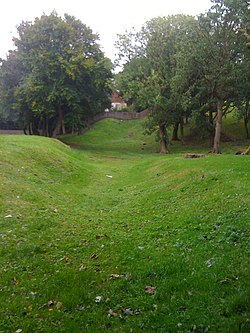
Tamfourhill is a working-class residential suburb of Falkirk within the Falkirk (council area), Scotland. It is located approximately 1.5 miles (2.5 kilometres) west of the city centre. The Falkirk Wheel is located just to the northwest of the village. Tamfourhill includes the residential area between the south side of the Forth & Clyde Canal and the north side of the Union Canal. It also contains the Tamfourhill Industrial Estate. To the west of the village is a well preserved part of the Antonine Wall, built in the 2nd century and Rough Castle.
Location Image
933 m

Rough Castle Fort

Rough Castle Fort is a Roman fort on the Antonine Wall roughly 2 kilometres south east of Bonnybridge near Tamfourhill in the Falkirk council area, Scotland. It is owned by the National Trust for Scotland.
Location Image
1.1 km

Watling Lodge

Watling Lodge was a Roman fortlet on the Antonine Wall in Scotland. It was located near what is now Lock Sixteen on the Forth and Clyde Canal in Falkirk with neighbouring forts at Rough Castle to the west and Falkirk to the east. There was also a fort at Camelon to the north. There was also a Roman temporary camp found a short distance south of the site.