


Femme juive aux citrons est une peinture à l'huile sur toile réalisée par Aleksander Gierymski en 1881. Le personnage qui y figure est le même que sur l'huile sur toile Femme juive aux oranges, du même artiste.
Gallery


Sponsored
Location

413 m
The Polish National Radio Symphony Orchestra) is one of Poland's radio orchestras and premier musical institutions. It was founded in 1935 in Warsaw and was later re-established in Katowice in 1945. Since 2006 it has been a "National Cultural Institution".

423 m
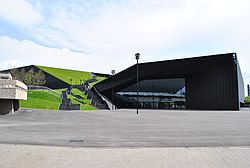
The Headquarters of the Polish National Radio Symphony Orchestra in Katowice is a concert hall located at 1 Wojciech Kilar Square in the Bogucice district of Katowice, Poland. It serves as the home of the Polish National Radio Symphony Orchestra.It is also a main component of the Katowice Culture Zone, which also includes the International Congress Centre and the Silesian Museum.
Constructed on the site of a former timber storage area of the Katowice Coal Mine, the building was officially opened on 1 October 2014. Designed by local architect Tomasz Konior, the structure draws inspiration from the architectural heritage of Upper Silesia, particularly the Nikiszowiec workers' housing estate. The concert hall has received numerous architectural awards for its design and cultural significance.
At the time of its opening, the concert hall was the largest concert and recording complex in Poland. In 2019, it joined the European Concert Hall Organisation, a network of European concert venues. Since its inauguration, the venue has become a highly popular cultural hub in Katowice, hosting performances by renowned artists and musical ensembles.

453 m
The Scientific Information Center and Academic Library is a joint scientific library of two universities in Katowice - the University of Silesia in Katowice and the University of Economics in Katowice. It is located in the heart of the university campus, in the center of the Silesian agglomeration.

509 m
Bogucice is a part and district of Katowice, Poland, located in the northern part of the city in the Chorzów Hills area, bordering Dąbrówka Mała, Szopienice-Burowiec, Zawodzie, Śródmieście, Koszutka, Wełnowiec-Józefowiec, and the city of Siemianowice Śląskie. It is one of the smallest districts of Katowice and serves mainly residential and cultural functions. The Culture Zone, which is located there, is home to the Polish National Radio Symphony Orchestra and the Silesian Museum.
Bogucice was founded in the 13th century under German law, with the first mention of the settlement dating to 1360. In the Middle Ages, it was one of the largest villages in the area of present-day Katowice, and it was the site of founding of the Parish of St. Stephen, the oldest Roman Catholic parish in Katowice, established between 1374 and 1396. Historical parts of Bogucice later developed into the districts of Koszutka and Zawodzie, as well as Kuźnica Bogucka, which was the nucleus of Katowice. Bogucice retained its agricultural character until the 19th century, when the Franz and Fanny zinc smelters, along with the Ferdinand Coal Mine, were established. Industry contributed to the development of the village and a rapid rise in its population. Bogucice was incorporated into Katowice on 15 October 1924. In 1999, the Katowice-Kleofas mine in the Katowice Mining District was closed, and at the beginning of the 21st century, its former grounds were transformed into the Culture Zone, which houses cultural institutions, various types of large-scale events, and new residential developments, including Pierwsza Dzielnica.
The main transport routes in Bogucice include Walenty Roździeński Avenue, while within the district, Leopold Markiefka Street and Katowicka Street are home to many commercial and service establishments, as well as historic buildings mostly from the turn of the 19th and 20th centuries. The Polish mountaineer Jerzy Kukuczka is also associated with Bogucice, where a housing estate was named after him. It has an area of 2.78 km2 and at the end of 2020, it had 16,538 inhabitants.
The most eminent piece of architecture in Bogucice is the Gothic Revival St. Stephen the Martyr's church, which was consecrated in 1894. The oldest cemetery in Katowice, first mentioned in 1598, was located in Bogucice, but there are no remains from this period today.
565 m
International Congress Centre in Katowice is a multipurpose conference and convention centre. It was opened to the public in 2015. It is owned by City of Katowice, Poland and since May 2016 is managed by the PTWP Event Center sp. z o.o. on a multi-year lease from the city.