


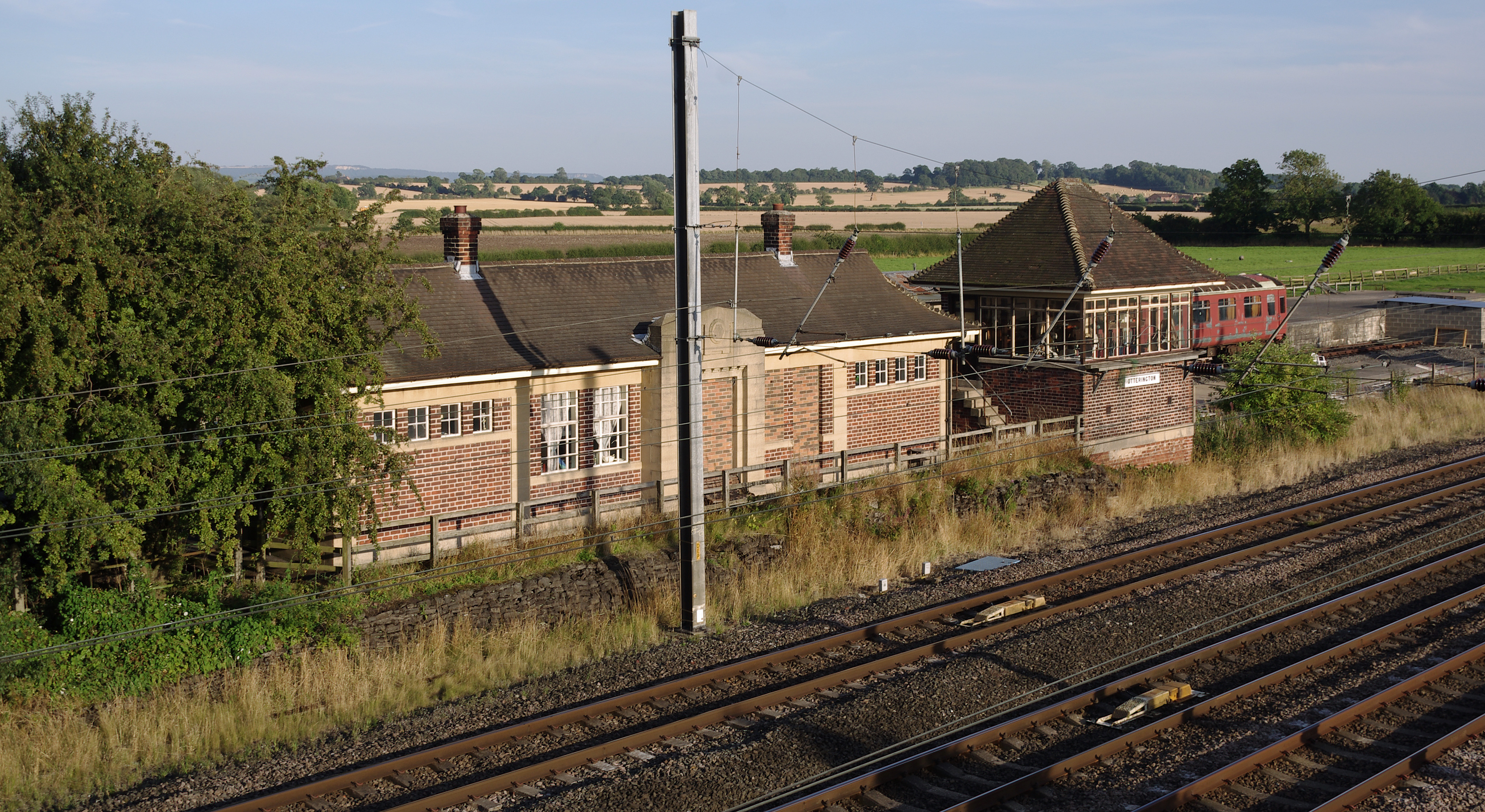
Otterington railway station was located in the village of South Otterington, North Yorkshire, on the East Coast Main Line. It opened in 1841 and closed in 1958. The station is now a private residence, though the platform can still be seen. The buildings date from the 1930s when the East Coast Main Line was widened.
Gallery

Sponsored
Location
1 explorer visited this place

768 m
South Otterington is a village and civil parish in the county of North Yorkshire, England. It is located on the A167 road 5 miles south of Northallerton and on the east bank of the River Wiske.
945 m
Thornton-le-Moor is a village and civil parish in the county of North Yorkshire, England, situated equidistantly from the towns of Thirsk and Northallerton.

951 m
Otterington Hall is a Grade II listed mansion in South Otterington, near Northallerton, North Yorkshire, England.
Otterington Hall lies in South Otterington, three miles south of Northallerton, on the A167.
One of the earlier occupants, from before 1831 until his death in 1837, was Captain John George Boss R.N. He had a distinguished naval career, being involved in the capture of several French vessels and the protection of British trading interests in the Caribbean during the Napoleonic Wars. He was a Member of Parliament for the Northallerton constituency and he gained the rank of captain in November 1833. He married twice: Charlotte Robinson in 1814, who died in 1832 aged 56, and Elizabeth Wylie in 1834.
Otterington Hall was the birthplace of British anti-fascist, linguist, and photographer, Alec Wainman.
It was home to the Furness family for many years, and they were responsible for planting much of its topiary gardens from the 1920s onwards, "one of the best topiary gardens in England and certainly the best in Yorkshire".
It has been home to Andy Preston, the Mayor of Middlesbrough and a former hedge fund manager, and his wife since at least 2007. In 2015, Preston was criticised for using his parents' Middlesbrough address on his nomination papers, rather than that of his actual home, but he denied breaking election rules.

998 m
St Andrew's Church is the parish church of South Otterington, a village in North Yorkshire, in England.
A church was built in South Otterington in the Norman period, and it was rebuilt in the late 17th century. The church only had space for ten pews, and in 1847 it was completely rebuilt, to a Neo-Norman design by Anthony Salvin. The construction was funded by William Rutson of Newby Wiske Hall, and cost £6,000. The new building was much larger, and had space for 300 worshippers. An organ was installed in 1899, stained glass was installed in 1907, and a lychgate was constructed in 1986. The building was grade II listed in 1987.
The church is built of stone with a stone slate roof. It consists of a nave, a north aisle, a south porch, a chancel and a west tower. The tower has three stages, clasping buttresses, a round-arched light in the middle stage, a south clock face, two-light bell openings under a larger round arch, a Lombard frieze, and a hipped pyramidal roof. Inside, the pulpit and reading desk are in the neo-Norman style, and there is a damaged mediaeval font in the north aisle.

1.1 km
Otterington Bridge is a historic structure connecting South Otterington and Newby Wiske, villages in North Yorkshire, in England.
The bridge, across the River Wiske, was constructed to carry the main road from Northallerton to Boroughbridge. It was designed by John Carr and was completed in 1776. The construction cost £680. The bridge was grade II listed in 1987.
The bridge is built of stone and consists of five segmental arches, the middle arch larger, with voussoirs and hood moulds. By the ends of the bridge are pilaster buttresses, and the parapet is coped.
The station became a listed building in 2018.
See also
Listed buildings in South Otterington