


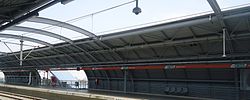
Presbítero Maestro is a Lima and Callao Metro station on Line 1. The station is located between El Ángel and Caja de Agua. It was opened on 3 January 2012 as part of the extension of the line from Miguel Grau to Bayóvar.
Location
1 explorer visited this place

370 m
The Church of the Holy Christ of Wonders is a Catholic church located at the junction of Jirón Áncash and Sebastián Lorente Avenue. Located in the neighbourhood of Barrios Altos. It is part of the historic centre of Lima, Peru. It is named after the devotion of the same name.

404 m
Presbyter Matías Maestro Cemetery, formerly the General Cemetery of Lima, is a cemetery, museum and historical monument located in the Barrios Altos neighbourhood of Lima District, in Lima, Peru. Inaugurated on May 31, 1808, it was the first pantheon in the city since burials were previously held in the city's churches. It was named in honour of its designer, Spanish priest Matías Maestro.
Its 766 mausoleums and 92 historical monuments of the most refined architecture of the 19th and 20th centuries keep the remains of several important political, military and literary figures of Peru, as well as the Crypt of Heroes monument, a mausoleum erected in honor of the heroes of the War of the Pacific.
525 m
El Ángel is a Lima and Callao Metro station on Line 1. The station is located between Miguel Grau and Presbítero Maestro. It was opened on 3 January 2012 as part of the extension of the line from Miguel Grau to Bayóvar.

762 m
El Ángel Cemetery is a cemetery located on the 17th block of Jirón Áncash, in Barrios Altos, between the districts of Lima and El Agustino, in the city of Lima, Peru. It was inaugurated by President Manuel Prado Ugarteche on June 27, 1959, due to the need of the city of Lima to have a new funerary space, since the capacity of the Presbítero Matías Maestro Cemetery had reached its maximum in 1955. It is owned and managed by the Charity of Lima.

942 m
San Cristóbal Hill is a hill in Lima, Peru. It overlooks the city's districts of Rímac and San Juan de Lurigancho, and forms part of the Andean Mountain Range. Once considered an Apu by the pre-Columbian cultures that originally inhabited the area, it was given its current name by Francisco Pizarro in 1535. It currently functions as a scenic viewpoint of the city and its surroundings, and also operates a museum at its summit.
Book your tour near
Presbítero Maestro metro station
Book Now
4.0
in partnership with
GetYourGuide.com