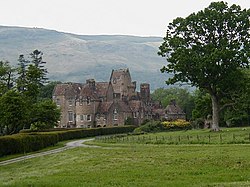
Glen Shira (Gaelic: Gleann Siara, "Glen of the eternal river") is a glen in Argyll and Bute, west of Scotland, at the northern end of Loch Fyne, just to the north of Inveraray. It is a Special Area of Conservation within the UK, bordered by Beinn Bhuidhe on the Glen Fyne side. Glen Shira is named after the River Shira, which runs through the centre of the glen. The river starts to the northeast at 350 metres elevation, near the start of the River Fyne. Shira runs into the 5 MW Sròn Mòr (Big Nose) power station dam, and then for about seven miles (eleven kilometres) down to and through Loch Dubh (Black Lake) at the base. From there, the waters flow into Loch Shira, a small inlet on Loch Fyne that, in turn, lends its name to the MV Loch Shira ferry. The glen is mostly taken up by a resident's sheep farm, but there are numerous houses within the glen, including Elrigbeg (Eileirig Beag), Elrig More (Eileirig Mór), Kilblaan and Drimlee (at the northern end). There is one single-track road which leads up the glen to the dam. This road splits into an access road (connected across the River Shira by a bridge) which leads to Drimlee. Asda also once produced a whisky called Glen Shira, although this had no connection to the actual glen.

Nearby Places View Menu
Location Image
3.3 km

River Shira

River Shira (Scottish Gaelic: Siara / Abhainn Siara) is the river that runs for about 7 miles through Glen Shira, in Argyll and Bute, west of Scotland. Originating to the north-east at 350 metres (1,150 ft) altitude, near the start of the River Fyne. The river runs into the Lochan Shira reservoir, feeding the 5 MW Sron Mor (Big Nose), Shira Hydro-Electric Scheme, at 340 metres (1,120 ft) altitude and dropping 49 metres (161 ft). The river includes a few waterfalls and islands, including Eilean an Eagail (The Island of Fear). The River Shira flows into Loch Dubh (Black Lake), where the Ancient Clan MacNaghten castle and crannogs used to be situated, then passes Stuart Liddell's house. Loch Dubh drains through the short (River Garron), then flows under the Garron Bridge into Loch Fyne, a sea loch.Gearr Abhainn The river lends its name to the ferry MV Loch Shira.
Location Image
5.6 km

Ardkinglas

Ardkinglas House is a Category A listed country house on the Ardkinglas Estate in Argyll, Scotland. The estate lies on the eastern shore of Loch Fyne, and the house is located close to the village of Cairndow. Dating back to the 14th century and originally a Campbell property, the estate now covers more than 12,000 acres (4,900 ha) of rolling hills and landscaped parkland. The centre of the estate was Ardkinglas Castle until this was replaced by a new house in the 18th century. This house was itself replaced by the present Ardkinglas House in the early 20th century, designed by Sir Robert Lorimer for Sir Andrew Noble. It remains the property of the Noble family, and is open to the public on a limited basis. The woodland gardens are open all year round.
Location Image
5.7 km

Loch Fyne Oysters

Loch Fyne Oysters is a seafood and meat company that operates on the banks of Loch Fyne, Scotland. The company created the Loch Fyne Restaurants chain, which was later sold to Greene King. Loch Fyne Oysters still owns the Loch Fyne brand and supplies its products to the restaurant chain.
Location Image
5.9 km

Shira Hydro-Electric Scheme

The Shira Hydro-Electric Scheme is a project initiated by the North of Scotland Hydro-Electric Board to use the waters of the River Shira, the River Fyne and other small streams to generate hydroelectricity. It is located between Loch Fyne and Loch Awe in Argyll and Bute, western Scotland. It consists of three power stations and three impounding dams. The remoteness of the area in which the scheme was built required 15 miles (24 km) of access roads to be built before the main works could begin. The three dams were all of different types; a round headed buttress dam; a concrete gravity and earth fill dam; and the first ever use of a prestressed gravity dam. The construction of the earth fill dam was hindered by four months of extremely wet weather. Clachan was the first large underground power station that the Board built, while Sron Mor was the first implementation of a pumped storage scheme, built in anticipation of the arrival of nuclear power generation. The power stations were commissioned in 1953, 1955 and 1957, in advance of the completion of work on the dams.