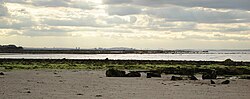
Seton Sands is a rocky beach to the east of Port Seton, East Lothian, Scotland. It is situated at the western end of Longniddry Bents and is part of the John Muir Way coastal walk. Low tide reveals many rock pools, then a flat sandy bed to the north which runs about 200 yards out to meet the Firth of Forth. South of the beach there is Seton Sands Holiday Park, a popular holiday destination in the summer months for many visitors, mostly families from the west coast of Scotland and the north of England. At the western edge of the caravan park is a public footpath leading to the Historic Scotland property Seton Collegiate Church, referred to locally as Seton Chapel. A regular bus service to Edinburgh terminates at Seton Sands (Lothian Buses no.26).

Nearby Places View Menu
Location Image
1.1 km

Longniddry Bents

Longniddry Bents is a beach just north of Longniddry in East Lothian, Scotland. The beach is almost 2 miles in length, which includes Gosford Bay to the east side, and the rockier Seton Sands to the west. Along the beach are the remains of a wall of concrete tank traps erected during World War II as protection from any attempted German invasion. Many of these are now hidden in the surrounding sea-grass and sea buckthorn bushes. The area is popular, mostly in the summer months, with local families, holidaymakers, picnickers, horseriders, ramblers, metal detectors, dogwalkers and the occasional kite buggy. The shallow bay is a popular watersports location for windsurfers, kitesurfers and sea kayaks. Many sea and wading birds frequent the area making it a regular haven for bird-watchers. A small community of rare water voles are known to reside around the several burns running out of the bents. Grey seals are often spotted to the west of the bay. The area is part of the Firth of Forth Site of Special Scientific Interest, a Special Protection Area and Ramsar Site. There are three car-parking areas, and the largest (No. 3) has good views west across the bay to Edinburgh's skyline and the Forth Bridge and Forth Road Bridge. Overnight parking is prohibited. Close to car park No.3 is Gosford House, and one of its two listed 18th century lodges can be seen on the main road. Longniddry Bents are part of the John Muir Way coastal walk and were presented with a Seaside Award (Rural) in 2006. In the East Lothian Council-produced series of leaflets on the John Muir Way, Longniddry is included in the leaflet "Cockenzie to Aberlady". The John Muir way is also part of the North Sea Trail of seven nations and 26 areas around the North Sea.
Location Image
1.2 km

Seton Collegiate Church

Seton Collegiate Church, known locally as Seton Chapel, is a collegiate church south of Port Seton, East Lothian, Scotland. It is adjacent to Seton House. The church is designated as a scheduled monument.
Location Image
1.3 km

Seton Palace

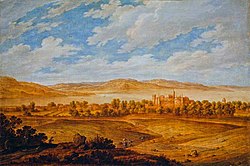
Seton Palace was situated in East Lothian, a few miles south-east of Edinburgh near the town of Prestonpans. Often regarded as the most desirable Scottish residence of the sixteenth and seventeenth centuries, the palace was erected in the 15th century by George, 4th Lord Seton. The palace belonged to the Lords Seton by the 1500s and was a popular retreat for Mary, Queen of Scots. She had spent her honeymoon with Lord Darnley there in July 1565. Mary played golf at Seton, and it was said she played "pall-mall and golf" as usual in the fields at Seton after Darnley's murder, "Pall-mall" was an early form of croquet. A marriage contract of Mary and Earl of Bothwell, made at Seton on 5 April 1567, and exhibited by Mary's enemies at the Hampton Court conference on 15 December 1568, was probably a contemporary forgery and the actual contract was made in Edinburgh on 14 May. In the 17th-century, the completed palace was triangular in plan, with three wings around a courtyard. In 1636, it was described as "a dainty seat placed by sea". The palace ruins were demolished in the 18th-century and Seton Castle was built on the site. The adjacent Seton family chapel, Seton Collegiate Church, survives and is open to the public in the care of Historic Environment Scotland.
Location Image
1.3 km

Seton Castle

Seton Castle or Seton Hall is an 18th-century Georgian castle-style house in East Lothian, Scotland. The house was Robert Adam's final project in Scotland.