


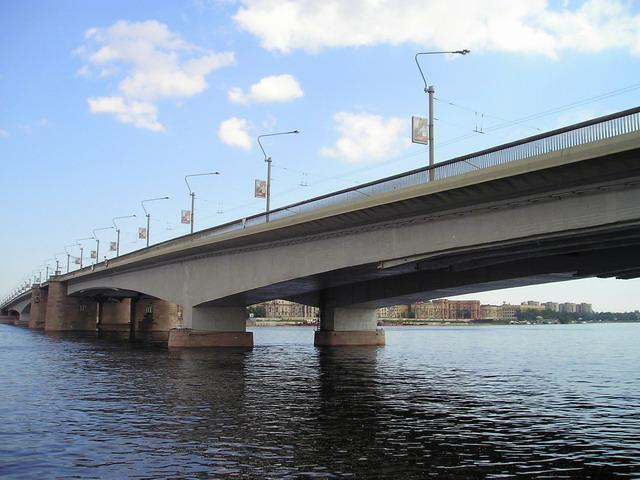
Le pont Alexandre-Nevski (en russe : Мост Александра Невского, Most Aleksandra Nevskogo) est un pont de Saint-Pétersbourg jeté sur la Neva. Le nom donné au pont est celui du légendaire commandant militaire et homme politique russe, saint Alexandre Nevski.
Location
1 explorer visited this place

37 m
The Alexander Nevsky Bridge in St Petersburg, Russia is named after the legendary Russian military commander and politician Alexander Nevsky. The bridge connects Alexander Nevsky Square and Zanevsky prospect thus linking the southern and the northern parts of the city. Until 2004, when the Big Obukhovsky Bridge was built, the Alexander Nevsky Bridge was the longest bridge across the Neva River in Saint Petersburg. Its length is 906 meters, and it is 35 meters wide.
The bridge was built from 1960 to 1965 under the working name of Old Neva Bridge.
Designed by the group of architects A. Zhuk, S. Mayofis and Y. Sinitsa, the bridge has complemented the look of adjacent buildings in the surrounding area. The project was led by a team of engineers of the "Lengiprotransmost" institute. Proof-testing was done by means of a column of army tanks. On November 5, 1965, the bridge was open for traffic.

348 m
The Higher Special Officer Classes of the Navy, formally the Higher Special Officer Order of Lenin Classes of the Navy, and known by its abbreviation VSOK VMF is a higher naval education institution in Saint Petersburg which educates serving officers of the Russian Navy in specialisations for more senior ranks and positions.
Since 2012 its official name has been Military Institute of the Military Scientific Center of the Navy "Naval Academy" ВУНЦ ВМФ «Военно-морская академия»).

517 m
Nikolskoe Cemetery is a historic cemetery in the centre of Saint Petersburg. It is part of the Alexander Nevsky Lavra, and is one of four cemeteries in the complex.
The third cemetery to be established in the monastery complex, the Nikolskoe Cemetery opened in 1863, and rapidly became a popular and exclusive burial site for the elite of Saint Petersburg society. It was carefully arranged and landscaped, with its cemetery church opening in 1871. Taking its name from this church, the Church of St. Nicholas, the cemetery functioned also a burial ground for the clergy and monks of the monastery. The wealthy and important of the city commissioned large and elaborate memorials during the later years of the nineteenth century and into the twentieth.
The cemetery fell into disrepair during the Soviet period. Unlike other cemeteries in the Lavra, it was not considered to have any particular historical or artistic value. The church was closed and repurposed, burials ceased, and some memorials of more significant figures were moved to other cemeteries, while others were lost or deliberately destroyed. Restoration work began in the 1970s, returning the site to its park-like form. A columbarium was built, the cemetery church reopened, and work to repair and refurbish the monuments began. Burials recommenced in the late 1970s, and now the cemetery includes prominent figures of Soviet and post-Soviet society, as well as those of the era of Imperial Russia.
543 m
Nikolskoe Cemetery is part of the Alexander Nevsky Lavra in the centre of Saint Petersburg, and contains a large number of burials as well as monuments and memorials to notable figures in Russian Imperial history, as well as those of Soviet and post-Soviet times.
The cemetery, opened in 1863, was the third cemetery in the monastery complex, after the original Lazarevskoe Cemetery in the 1710s, and the Tikhvin Cemetery in 1823. It became known as the Nikolskoe after the construction of the Church of St. Nicholas between 1868 and 1871 to the design of diocesan architect Grigory Karpov. From its inception burial there was restricted to the elite of society, the monastery's Spiritual Council noting that "the Lavra cemetery is not open to everyone, as are the city cemeteries, but only a few persons from the government service and persons with honorary titles are buried here." Part of the cemetery also served as the burial site for the Monastery's monks and the metropolitans of St. Petersburg, leading to the name Bratskoe, or "Brotherhood" section. Wealthy patrons commissioned large chapels and crypts, with elaborate decorations and reliefs from prominent artists such as Nikolay Laveretsky, Ivan Podozerov, Robert Bach and Ivan Schroeder.
Despite this the cemetery was not considered to have any particular artistic or historical value during the Soviet period. It was closed in 1927 and sporadic efforts were made during the 1930s and 1940s to eliminate it, with the graves of several prominent figures were transferred to the Lazarevskoe, Tikhvin and Volkovo cemeteries; including Vera Komissarzhevskaya, Ivan Goncharov, Anton Rubinstein and Boris Kustodiev. Other graves were lost or destroyed. The Church of St Nicholas was closed in 1932, and the cemetery fell into neglect.
The Nikolskoe Cemetery was restored and landscaped in the 1970s, with a columbarium built between 1979 and 1980. The cemetery church was repaired and reconsecrated on 22 April 1985. Burials resumed in the late 1970s, and since 1989 a comprehensive restoration of monuments has been underway.

543 m
Grigory Ivanovich Butakov was a Russian admiral who fought in the Crimean War. Butakov is widely credited as being the father of steam-powered ship tactics during the 19th century. He was involved in the first battles of the Crimean War, which includes the first sea battles involving steam-powered ships. Butakov wrote of his experiences in his book: New Principles of Steamboat Tactics, which won him the Demidov Prize. In 1881 Butakov assumed the role of Commander-in-Chief of the Port of St. Petersburg. He was also made a member of the State Council in March 1882. Shortly after gaining both titles however, Butakov fell seriously ill, and died on 31 May 1882, aged 62. The minor planet 4936 Butakov was named in his memory.