


The Parish of Monkwearmouth is a Church of England parish in Monkwearmouth, England, served by the churches of St Peter's, All Saints' and St Andrew's.
Location
1 explorer visited this place
55 m
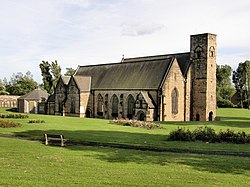
Monkwearmouth is an area of Sunderland, Tyne and Wear in England. Monkwearmouth is located at the north side of the mouth of the River Wear. It was one of the three original settlements on the banks of the River Wear along with Bishopwearmouth and Sunderland. It includes the area around St. Peter's Church, founded in 674 as part of Monkwearmouth-Jarrow Abbey, and was once the main centre of Wearside shipbuilding and coalmining in the town. It is now host to a campus of the University of Sunderland and the National Glass Centre. It is served by the three Church of England churches of the Parish of Monkwearmouth. The first nineteenth-century Catholic church built in Monkwearmouth was St Benet's Church which remains active today.
Monkwearmouth is across the river from the Port of Sunderland at Sunderland Docks.
The locals of the area were called "Barbary Coasters". The borough stretches from Wearmouth Bridge to the harbour mouth on the north side of the river and is one of the oldest parts of Sunderland.
The former railway station, closed in 1968 by the Beeching Axe, is now the Monkwearmouth Station Museum and features a restored booking office dating from the Edwardian period. Since 2002, Monkwearmouth has once again been served by rail transport, this time via St Peter's Tyne and Wear Metro station a few hundred metres south of the old station.
Wearmouth Colliery, a coal mine, was closed in December 1993 after it had been in operation for over 100 years. The site is now the home of the Stadium of Light, which opened in July 1997 and is the home of the football club Sunderland A.F.C., who had previously played at Roker Park.
Monkwearmouth was part of the Sunderland North parliamentary constituency for elections to the House of Commons of the United Kingdom. Monkwearmouth is now part of Sunderland Central.
In 1891 the civil parish had a population of 9116. On 25 March 1897 the parish was abolished and merged with Sunderland. In 1974 it became part of the metropolitan district of Sunderland.
192 m
All Saints' Church is a church in Monkwearmouth, Sunderland, England. A parish of All Saints was formed in 1844 when it became clear that there was no longer enough room in the only parish church for Monkwearmouth, and a church for the new parish was completed and consecrated in 1849. One of its vicars was Alexander Boddy, and so All Saints' became known as the birthplace of modern British Pentecostalism. All Saints' is now again part of the parish of Monkwearmouth.

256 m
The Institute for International Research in Glass promotes and facilitates research in Glass at a national and international level. It is part of the University of Sunderland, located in the National Glass Centre on the bank of the river Wear.

267 m
St Benet's Church is a Catholic church in Monkwearmouth in Sunderland. It was built in 1889 and designed by Archibald Matthias Dunn and Edward Joseph Hansom. It is located on the corner of Thomas Street North and George Street North, half a kilometre east of the Stadium of Light. From 1900 to 2011, the Redemptorists served the parish. The church is now once again served by priests from the Diocese of Hexham and Newcastle. When it was built, it was the first Catholic church in Sunderland to be built north of the River Wear in the nineteenth century.
337 m
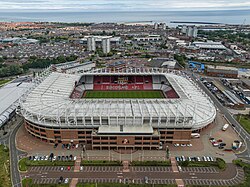
The Stadium of Light is an all-seater football stadium in Sunderland, England, and the eighth and current home to Sunderland. With seating for 49,000 spectators, the Stadium of Light is the 10th largest football stadium in England. The stadium primarily hosts Sunderland home matches. The stadium was named by chairman Bob Murray to reflect the coal mining heritage of the North East and the former Monkwearmouth Colliery site on which it stands. A Davy lamp monument stands at the entrance to reflect the coal mining industry that brought prosperity to the town.
As well as hosting Sunderland games, the stadium has hosted three matches for the England national football team, as well as an England under-20, an England under-21 and two England women's team matches. With an original capacity of 42,000, it was expanded in 2000 to seat 49,000. Its simple design is apparently to allow for redevelopments up to a capacity of 64,000. The attendance record at the Stadium of Light is 48,353 set on 13 April 2002, when Sunderland played Liverpool with the visitors running out 1–0 winners. Along with hosting football matches, the stadium has played host to performers such as Beyoncé, Rihanna, Oasis, Take That, Kings of Leon, P!nk, Coldplay, Spice Girls and Elton John. The ground also holds conference and banqueting suites, the 'Black Cats Bar', and a club shop selling Sunderland merchandise.
History
The parish was originally only served by St Peter's, but new parishes of All Saints and St Andrew were split off from it in 1844 and 1906 respectively owing to urban expansion in the area. These parishes were later reunited to the parish of Monkwearmouth, which now includes all three churches. St Peter's was founded in AD 674–5 as one of the two churches of the Benedictine double monastery of Monkwearmouth–Jarrow Abbey.