


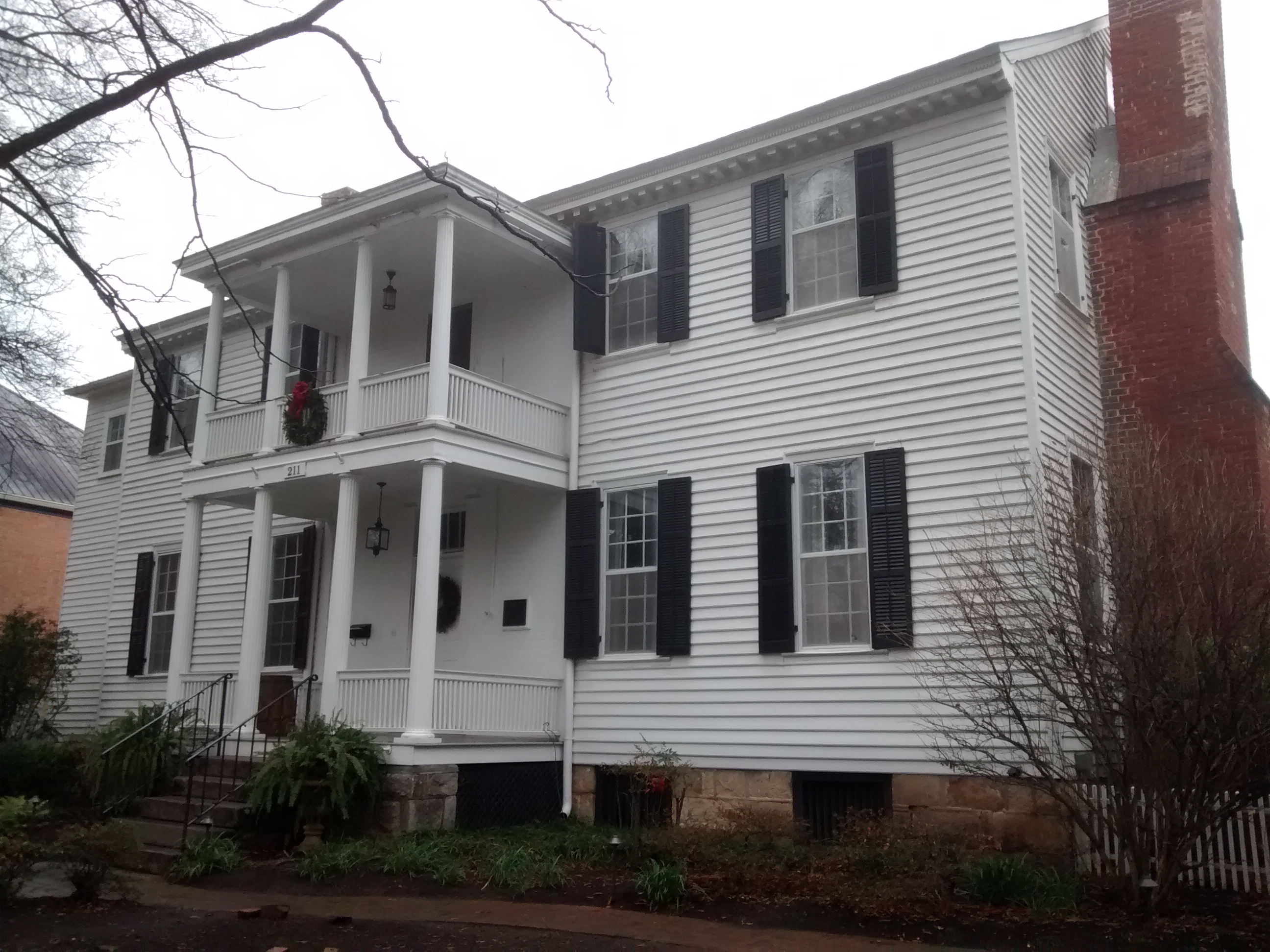
Haywood Hall, also known as the Treasurer John Haywood House, is a historic home located at Raleigh, Wake County, North Carolina, United States. It was built in 1792, and is a two-story, five-bay, Federal-style frame dwelling with a central hall plan. It features a two-story front porch with attenuated fluted Doric order columns.
Location
1 explorer visited this place

150 m
The North Carolina Department of Military and Veterans Affairs is a state agency designed to advocate for the relationship the state has with its military and veterans' installations and populations. It was created by the North Carolina General Assembly with the support of Governor Pat McCrory. The current head of the Department is Secretary Jocelyn Mitnaul Mallette, an Air Force veteran appointed by Governor Josh Stein. Prior to the creation of the Department, the Division of Veterans Affairs was under the Department of Administration, while all military-related matters fell under the Department of Commerce.
154 m
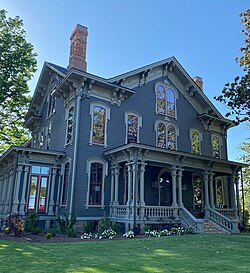
The Andrews-Duncan House is a historic house located at 407 North Blount Street in Raleigh, North Carolina, United States. Built in 1874 for a prominent businessman, the Italianate style home was designed by architect George S. H. Appleget. The house was added to the National Register of Historic Places in 1972 and is currently owned by the state government. A large tree named after a presidential candidate once stood behind the house and is commemorated with a historical marker.

194 m
The Heck-Andrews House was finished in 1870 and was one of the first houses in Raleigh, Wake County, North Carolina to be constructed after the American Civil War. It is located at 309 North Blount Street. It was created by G.S.H. Appleget for Mrs. Mattie Heck, the wife of Colonel Jonathan McGee Heck. It is on the National Register of Raleigh Historic Property. The house has a dramatic central tower capped with a convex mansard roof with a balustrade. The central part of the 2+1⁄2-story, Second Empire style frame dwelling is enclosed with a concave mansard roof with patterned slate.
The house was owned by the Heck family until 1916 and was sold to A.B. Andrews. In 1948, Andrews heir sold the house to Julia Russell. The North Carolina government bought the house in 1987 planning to refurbish the structure. The exterior refurbishment was completed, however the State sold the house to the North Carolina Association of Realtors in January 2016 who plan on using it as an office building.
It was listed on the National Register of Historic Places in 1972.

200 m
The Raleigh and Gaston / Seaboard Coast Line Building is an historic building in Raleigh, North Carolina, that was once home to the Raleigh and Gaston Railroad and subsequently the Raleigh office of the Seaboard Coast Line Railroad. The three-story brick building is one of Raleigh's earliest surviving office buildings and served as a railroad office for more than 100 years.
The first train to arrive in Raleigh came in 1840, five years after the Raleigh and Gaston Railroad was chartered. The railroad was sold under foreclosure and taken over by the State of North Carolina in 1845. Private stockholders were later able to acquire a controlling interest from the state, in 1867. The building was commissioned while the railroad was under state control and construction of two stories was started in 1861. A third and final story had been added by 1891. The Raleigh and Gaston Railroad and several associated railroads formed the Seaboard Air Line Railroad in 1893, and later merged with the Atlantic Coast Line Railroad to form the Seaboard Coast Line Railroad in 1967.
The building was listed on the National Register of Historic Places on May 6, 1971, at its original location of 325 Halifax Street. At that time, the building was still in use for its original purpose as a railroad company office. The state of North Carolina purchased the land in 1977 and moved the building to its present location at 413 North Salisbury Street, re-designating it as a Raleigh Historic Landmark in 1990. Since 2015 the building has served as the headquarters of the North Carolina Department of Military and Veterans Affairs.
221 m
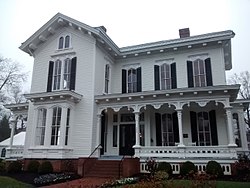
Merrimon-Wynne House, also known as the Merrimon House and Wynne Hall, is a historic home located at Raleigh, Wake County, North Carolina. The house, located within the Blount Street Historic District, was built about 1875, and is a two-story, four-bay, Italianate style frame dwelling with a cross-gabled roof and somewhat irregular massing. It is sheathed in weatherboard and features a Stick Style / Eastlake movement front porch with abundant ornamentation. The house was remodeled and complementary bay windows added about 1910. The house was built by Senator Augustus Summerfield Merrimon.
The property was previously listed in the National Register of Historic Places in 1975 as the Merrimon House, when it stood at 526 North Wilmington Street. It was delisted in 2008, after it was relocated. It was relisted on the National Register of Historic Places in 2014 at its new location.
It was the home of North Carolina State Treasurer John Haywood (1754–1827). It is now open as a historic house museum. It was listed on the National Register of Historic Places in 1970. It is located in the Capitol Area Historic District.
