


The Simpsonville Methodist Church is a historic church on First Street in Simpsonville, Kentucky. It was built in 1876 and added to the National Register in 1988. The first church on this location was built in 1840; it had elevated pews and 32 members in 1842. This church was built in 1876 as the Methodist Episcopal Church South for cost of $7500.
Gallery


Sponsored
Location

31 m
The Bank of Simpsonville in Simpsonville, Kentucky was listed on the National Register of Historic Places in 1988. Its building, built c.1902, is located at Third and Railroad Streets in Simpsonville.
It was deemed notable "as a rare surviving example of rural commercial development in Shelby county for the period. The
building is a prominent visual feature."

756 m
The Simpsonville Christian Church is a historic church on US 60 in Simpsonville, Kentucky. It was built in 1875 and added to the National Register of Historic Places in 1988.
It is believed to have been built on the site of a former slave market.
971 m
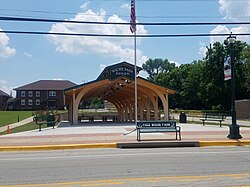
Simpsonville is a home rule-class city in Shelby County, Kentucky, in the United States. It is located 8 miles west of Shelbyville, Kentucky and 23 miles east of Louisville situated along U.S. 60. As of the 2020 census, Simpsonville had a population of 2,990.

1.6 km
The Whitney Young Birthplace and Museum is a historic house museum on the campus of the former Lincoln Institute in rural Shelby County, Kentucky, near Shelbyville. It was the birthplace and childhood home of Whitney M. Young Jr., an American civil rights leader. Young became prominent for his leadership of the National Urban League between 1961 and 1971. The house is now managed by the Lincoln Foundation, a successor to the Lincoln Institute, as a museum to its and Young's history. The house appears on the National Register of Historic Places and was designated as a National Historic Landmark in 1984.

1.7 km
Wickland is a historic house in Shelbyville, Kentucky, United States, across from Prospect Avenue on Kentucky Street. It is named for the Wickland mansion in Bardstown, Kentucky, and is part of the Shelbyville Multiple Resource Area.
Wickland was built in 1901 by Charles Cotesworth Marshall, who was a circuit judge and Shelby County attorney. His wife Elizabeth Wickliffe Marshall's ancestral home was the Bardstown Wickland; Elizabeth was the daughter of the former governor of Louisiana, Robert C. Wickliffe. Marshall was born in Mississippi on May 26, 1868, to former Confederate soldier Charles C. Marshall and Mattie Marshall, but was reared in Shelbyville by his aunt due to his parents dying when he was one year old, and was taught at various schools, both public and private, around Shelbyville. His aunt was the wife of the Shelby County judge. Other owners of the property were Arthur Johnston, Hubert Johnston, B.A. Thomas, G. William Johnston, and Kenneth Harris.
Wickland is considered a superb example of Classical Revival architecture. It is a two-story brick structure, with a pyramidal roof, right-side semi-octagonal projecting bay, and a central passage plan. The total property is less than a half-acre.
Wickland was one of several buildings studied since 1979 for the Shelbyville Multiple Resource Area. The Kentucky Heritage Council funded the effort of the Shelby County Historical Society to add many Shelbyville structures to the National Register, including Wickland. The original Wickland was placed on the Register a decade beforehand.
It had 210 members during 1877–1880.