

 English
 Français
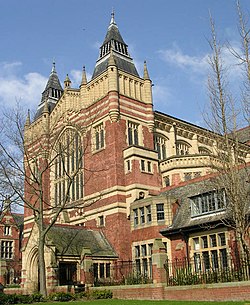
Great Hall of the University of Leeds
The Great Hall is a grade II listed Gothic Revival building located at the University of Leeds in West Yorkshire, England. The building is primarily used for formal occasions such as graduation ceremonies and university students' examinations. Its undercroft was previously utilised to house the university library collections before the Brotherton Library opened in 1936. The Great Hall is one illustration of the many diverse styles of buildings on the campus of the University of Leeds; it is an example of red brick architecture associated with the term red brick university.
Nearby Places View Menu

89 m
Brotherton Library
The Brotherton Library is a 1936 Grade II listed Neoclassical building with some art deco fittings, located on the main campus of the University of Leeds. It was designed by the firm of Lanchester & Lodge, and is named after Edward Brotherton, 1st Baron Brotherton, who in 1927 donated £100,000 to the university as funding for its first purpose-built library.
The Brotherton Library is a hub in what has become Leeds University Library. Initially, it contained all of the university's books and manuscripts, with the exception of books housed in the separate Medical Library and Clothworkers' (Textile) Library. As of 2022 it contains the main collections in arts and languages and the Special Collections' Research Centre, and it houses part of the University Library's administration. Science, engineering and social science research collections are located in the Edward Boyle Library, while the Laidlaw Library contains core texts for undergraduates and a high demand collection and the Health Sciences Library contains the University Library's medical and related collections, with a small satellite library at St James's University Hospital. The University Library is also responsible for the University Archives, the Stanley and Audrey Burton Gallery, the Treasures Gallery and the International Textile Collection.

112 m
Parkinson Building
The Parkinson Building is a grade II listed building in Greek Revival style by Thomas Lodge located at the University of Leeds in West Yorkshire, England. The clock tower is the highest point of the building and stands at 57 metres (187 ft) tall, making it the 17th-tallest building in the city of Leeds.
The building is named after Frank Parkinson, a major benefactor to the university, who donated £200,000 towards the cost of the new building. The building construction started in 1938; however, the outbreak of the Second World War in 1939 halted building work, with construction resuming and finishing in 1951. The building was officially opened on 9 November 1951 by The Princess Royal, Chancellor of the university from 1951 to 1965.
A prominent landmark in Leeds, the tower can be seen for miles around the campus and from the M621 motorway some 12.1 miles (19.5 km) from the site, and has become emblematic of the university itself with Leeds incorporating the clock tower into the university logo in 2006.

112 m
Institute for Transport Studies, University of Leeds
The Institute for Transport Studies (ITS) is a school within the Environment Faculty of the University of Leeds in the UK. The institute is one of the leading centres for teaching and research in transport in the United Kingdom, and attracts a number of students from outside the UK for its Masters and PhD programmes.

112 m
Leeds University Business School
Leeds University Business School is a business school in the University of Leeds, in Leeds, West Yorkshire, England. The school is accredited by AACSB, AMBA and EQUIS.