


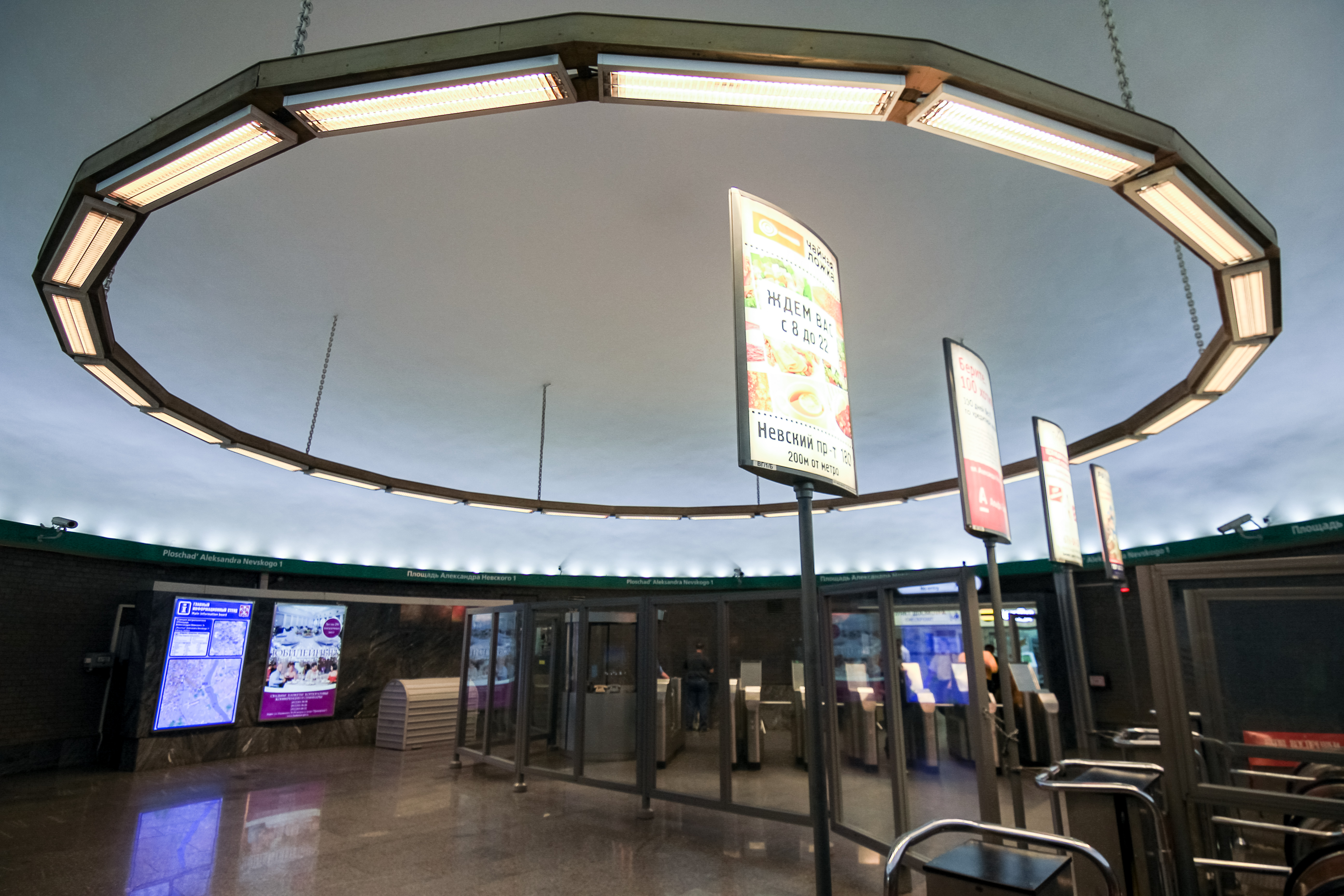
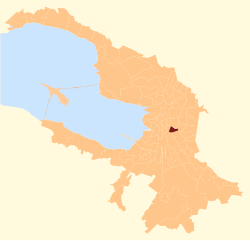
Plochtchad Alexandra Nevskogo 1 (en russe : Пло́щадь Алекса́ндра Не́вского-1) est une station de la ligne 3 du Métro de Saint-Pétersbourg. Elle est située sous la place éponyme Plochtchad Alexandra Nevskogo, dans le raïon Central, à Saint-Pétersbourg en Russie. Mise en service en 1967, elle est desservie par les rames de la ligne 3 du métro de Saint-Pétersbourg.
Book your tour near
Plochtchad Alexandra Nevskogo 1
Book Now
4.2
in partnership with
GetYourGuide.com
Gallery




Sponsored
Location
1 explorer visited this place
0 m
Ligovka-Yamskaya Municipal Okrug is a municipal okrug in Tsentralny District, one of the eighty-one low-level municipal divisions of the federal city of St. Petersburg, Russia. As of the 2010 Census, its population was 16,825, up from 14,740 recorded during the 2002 Census.

94 m
The Saint Petersburg Theological Academy is a higher education institution of the Russian Orthodox Church, located in Saint Petersburg, Russia. The academy prepares theologians, clergymen, singers and icon writers for the Eastern Orthodox Church and grants bachelor, master, candidate and doctorate degrees. It was founded in 1797 by Metropolitan Gabriel of Saint Petersburg, as part of the Alexander Nevsky Lavra.
At the turn of the 20th century the Saint Petersburg Theological Academy was one of four religious academies of the Russian Orthodox Church. The class of 1898 had a total of 235 students regularly attending classes.

518 m
Kazachye Cemetery, formerly known as Communist Square and also known as the Internal Cemetery of the Alexander Nevsky Lavra is a historic cemetery in the centre of Saint Petersburg. It is part of the Alexander Nevsky Lavra, and is one of four cemeteries in the complex.
Established during the Russian Revolution in 1917 as a burial ground for Cossacks killed during the July Days, it was soon used for the interment of several prominent communist activists, and was the site of mass graves of those who had died to defend communism in the Russian Civil War. In light of this, it became known as "Communist Square". The graves of several high profile military leaders and scientists were located here during the 1920s and 1930s, with further burials taking place during the siege of Leningrad. More interments took place in the postwar years, but the number eventually declined during the last years of the twentieth century, until the cemetery was closed. An estimated 700 people were buried here during the years of its operation, and in 2009 its original name, "Kazachye", was restored.

525 m
Lazarevskoe Cemetery, part of the Alexander Nevsky Lavra in the centre of Saint Petersburg, is the oldest surviving cemetery in the city and contains a large number of burials as well as monuments and memorials to notable figures in Russian Imperial history.
Burials began in 1717 when Natalya Alexeyevna, the sister of Peter the Great, was interred in the burial vault of the Church of St Lazarus, from which the cemetery took its name.
During the early years of its existence, it required the Emperor's permission to allow burials in the cemetery, making it the chosen location for the burial plots of St Petersburg's elite. By the end of the eighteenth century burial was extended to the wealthy merchant class, in exchange for the payment of large sums of money.
By the nineteenth century, the cemetery was becoming overcrowded, and the first of the new cemeteries in the Lavra, the Tikhvin Cemetery, was opened in 1823. Burials in the Lazarevskoe Cemetery became less frequent in the nineteenth century, and in the twentieth century occurred in only exceptional cases. One of the last people to be interred was Count Sergei Witte in 1915, and in 1919 the cemetery was closed to new burials.
During the Soviet period the cemetery was closed and placed under state protection, administered by the society "Old Petersburg". In 1932 it was declared a museum and part of the State Museum of Urban Sculpture. Redevelopment work in the Soviet period involved clearing away those memorials thought to have low historical or artistic interest, while those considered to have higher historical or artistic interest were brought from other cemeteries across the city. Large scale restoration work was carried out after the ending of the Siege of Leningrad, with the museum opening to the public in 1952.
Containing a large number of famous burials and elaborate funerary sculpture from some of the country's leading artists, the cemetery has been called the Necropolis of the XVIII century. Examples of the work of Ivan Martos, Mikhail Kozlovsky, Vasily Demut-Malinovsky, Andrey Voronikhin, Fedot Shubin, Fyodor Tolstoy and other masters can be seen. Famous people interred in the cemetery include early associates of Peter the Great, such as Field Marshal Boris Sheremetev, General Adam Veyde, and Court Physician Robert Erskine. The graves of academics Mikhail Lomonosov and Stepan Krasheninnikov; playwrights Denis Fonvizin and Yakov Knyazhnin; architects Ivan Starov, and Andrey Voronikhin; statesmen and politicians Alexander Stroganov, Nikolay Mordvinov, Mikhail Muravyov-Vilensky and Sergei Witte; and military officers such as Vasily Chichagov are also to be seen. The family vaults of the Beloselsky-Belozersky, Trubetskoy, Volkonsky and Naryshkin ancient noble houses were located here, as were those of some of the prominent merchant dynasties such as the Demidovs and Yakovlevs. Art historian Nikolai Vrangel wrote "It was as if all those who had once formed a close circle of court society gathered here after death. A whole epoch, a whole world of obsolete ideas, almost all the court society of Elizabeth, Catherine and Paul were buried in the small space of the Lazarevskoe cemetery".
The remains of a number of famous figures in Russian history were reburied in the cemetery during the Soviet period, among whom were architect Jean-François Thomas de Thomon, mathematician Leonhard Euler and engineer Agustín de Betancourt.

525 m
The Feodorovskaya Church, or in full, the Church of the Holy Prince Feodor of Novgorod is a Russian Orthodox church in Saint Petersburg. It is in the Diocese of Saint Petersburg and is part of the Alexander Nevsky Lavra.
The church was built as part of the southern extension from the Holy Trinity Cathedral, creating a symmetrical effect. The Feodorovskaya Church was designed as the counterpart to the Annunciation Church. Construction work began in 1745 and took a number of years. As completed the two-storey building hosted two churches, one on the upper floor, dedicated to Feodor of Yaroslav, and the ground floor dedicated to Saint John Chrysostom. After repairs in the 1840s the churches were re-consecrated. This time the upper church was dedicated to Feodor of Yaroslav, while the ground floor was dedicated to Saint Nicholas.
The church became a popular site for burials of leading churchmen, Georgian royalty, and other elite members of Saint Petersburg society. In 1891 an extension was opened, and also consecrated as a separate church, in the name of Saint Isidore of Pelusium. Over the next twenty-five years, around 150 burials took place. The churches were closed in 1931, during the Soviet period, and allocated to various organisations. The church served as a dormitory and office space. Almost all of the graves were destroyed during this period, with the exception of two that were transferred to one of the lavra's cemeteries. The church was returned to the monastery officials in 1996 and underwent a complex restoration, being re-consecrated in 2018.
Elle est en correspondance directe avec la station Plochtchad Alexandra Nevskogo 2 desservie par la ligne 4.