

 English
 Français

Arbroath Abbey
Arbroath Abbey, in the Scottish town of Arbroath, was founded in 1178 by King William the Lion for a group of Tironensian Benedictine monks from Kelso Abbey. It was consecrated in 1197 with a dedication to the deceased Saint Thomas Becket, whom the king had met at the English court. It was William's only personal foundation — he was buried before the high altar of the church in 1214. The last Abbot was Cardinal David Beaton, who in 1522 succeeded his uncle James to become Archbishop of St Andrews. The Abbey is cared for by Historic Environment Scotland and is open to the public throughout the year (entrance charge). The distinctive red sandstone ruins stand at the top of the High Street in Arbroath.
Nearby Places View Menu

125 m
St Andrew's Parish Church, Arbroath
St Andrew's Parish Church is a congregation of the Church of Scotland located in Arbroath, Angus, Scotland.
The church building was constructed in the late 1880s. In 2007 the church underwent extensive refurbishment, funded by donations from the congregation and a grant from the Church of Scotland. The final minister of the congregation (before it united) was the former Moderator of the General Assembly of the Church of Scotland, Right Rev. Martin Fair.
The church houses the 7th Arbroath Boys' Brigade and other youth groups.
It is now part of the larger Arbroath and District Church, an amalgamation of nine churches in Arbroath and the surrounding area. It is now a team ministry, with Christine Hay, Peter Philips and Judith MacLeod filling the three allocated ministry posts. The St Andrew's Church is still in use each Sunday for worship.

285 m
Arbroath
Arbroath () or Aberbrothock (Scottish Gaelic: Obar Bhrothaig [ˈopəɾ ˈvɾo.ɪkʲ]) is a former royal burgh and the largest town in the council area of Angus, Scotland, with a population of 23,902. It lies on the North Sea coast, some 16 miles (26 km) east-northeast of Dundee and 45 miles (72 km) south-southwest of Aberdeen.
There is evidence of Iron Age settlement, but its history as a town began with the founding of Arbroath Abbey in 1178. It grew much during the Industrial Revolution through the flax and then the jute industry and the engineering sector. A new harbour was created in 1839; by the 20th century, Arbroath was one of Scotland's larger fishing ports.
The town is notable for the Declaration of Arbroath and the Arbroath smokie. Arbroath Football Club holds the world record for the number of goals scored in a professional football match: 36–0 against Bon Accord of Aberdeen in the Scottish Cup in 1885.
336 m
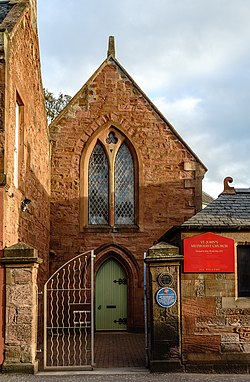
St John's Methodist Church, Arbroath
St John's Methodist Church, on Ponderlaw Street, Arbroath, Scotland, was founded by John Wesley on 6 May 1772. The nave is octagonal and the church has been nicknamed Totum Kirkie from 'totum', an eight-sided spinning top, and 'kirk', the Scottish word for church. It is a listed building and the second-oldest Methodist church in Scotland.

421 m
Church of St Mary the Virgin, Arbroath
The Church of St Mary the Virgin is a Scottish Episcopal Church, in Arbroath, Angus, Scotland. It is part of the Diocese of Brechin.