


La maison Grande Cour, également appelée ancienne maison Desbassayns ou école franco-chinoise, est un bâtiment remarquable de l'île de La Réunion, département d'outre-mer français, dans le sud-ouest de l'océan Indien. Ancienne maison des maîtres d'une habitation agricole sucrière appartenant à la famille Desbassayns, elle est située au lieu-dit Saint-Charles, n°233 Chaussée Royale à Saint-Paul, et relève des Monuments historiques depuis le 8 octobre 1984, ses façades et toitures étant alors classées tandis que sont inscrits le portail d'entrée et le jardin avec sa fontaine.
Book your tour near
Maison Grand Cour
Book Now
4.0
in partnership with
GetYourGuide.com
Gallery


Sponsored
Location
1.2 km
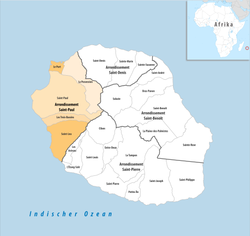
The arrondissement of Saint-Paul is an arrondissement of France in the Réunion department in the Réunion region. It has five communes. Its population is 215,613, and its area is 537.2 km2.
1.4 km
The cantons of Saint-Paul are administrative divisions of Réunion, an overseas department and region of France. Since the French canton reorganisation which came into effect in March 2015, the city of Saint-Paul is subdivided into 3 cantons. Their seat is in Saint-Paul.
1.4 km
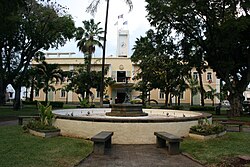
The Hôtel de Ville is a municipal building in Saint-Paul, Réunion, in the Indian Ocean, standing on Place Général de Gaulle.

1.4 km
Saint-Paul is the second-largest commune in the French overseas department of Réunion. It is located on the extreme west side of the island of Réunion.

1.5 km
The raid on Saint-Paul was an amphibious operation conducted by British forces against the port of Saint-Paul in the French colony of Isle Bonaparte during the Napoleonic Wars. It was launched on 20 September 1809 as both a precursor to a future full-scale invasion of Isle Bonaparte and in order to capture the French frigate Caroline and the East Indiamen she had seized in the action of 31 May 1809 which were sheltering in the harbour. The operation was a complete success, with British storming parties capturing the batteries overlooking the port, which allowed a naval squadron under Commodore Josias Rowley to enter the bay and capture the shipping in the harbour.
The French defenders of the town, despite initially resisting the attack, were unable to prevent the seizure of the port's defensive fortifications. The British force later withdrew under pressure from the main garrison of the island, burning warehouses containing over £500,000 worth of silk captured from British merchant ships. Ultimately the French were unable to effectively oppose the invasion, the island's governor General Nicolas Ernault des Bruslys retreating to Saint-Denis rather than engage the British and later committing suicide. The transportation of forces from the recently captured island of Rodriguez, the co-ordination of land and naval forces and the failure of the French defenders to co-ordinate an effective response were all features of the subsequent invasion and capture of Isle Bonaparte in July 1810.