


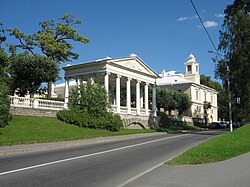
L'église Sainte-Marie-Madeleine (це́рковь Свято́й Мари́и Магдали́ны) est une église orthodoxe située en Russie à Pavlovsk à côté du palais de Pavlovsk. Elle est de style néoclassique et a été construite par Giacomo Quarenghi de 1781 à 1784.
Gallery


Sponsored
Location
275 m
Pavlovsk of Russia) is a municipal town in Pushkinsky District in the suburban part of the federal city of Saint Petersburg, Russia, located 30 kilometers south from Saint Petersburg proper and about 4 kilometers southeast from Pushkin. Population: 16,087 . Known since the late 18th century, when Saint Petersburg was the capital of Russian Empire, as a countryside residence of Russian royal family commissioned creation of the town's landmark -palace with a large park, now parts of its federal museum reserve.
The town developed around the Pavlovsk Palace, a major residence of the Russian imperial family. Between 1918 and 1944, its official name was Slutsk, after the revolutionary Vera Slutskaya, and then was changed back to Pavlovsk. Pavlovsk is part of the UNESCO World Heritage Site "Historic Centre of Saint Petersburg and Related Groups of Monuments".

401 m
Pavlovsk Palace is an 18th-century Russian Imperial residence built by the order of Catherine the Great for her son Grand Duke Paul, in Pavlovsk, within Saint Petersburg. After his death, it became the home of his widow, Maria Feodorovna. The palace and the large English garden surrounding it are now a Russian state museum and public park.

749 m
The Milk House is an architectural monument located in Pavlovsk, within the central district of Pavlovsk Park. During its construction, it stood on the outskirts of the park, near the forest where cows grazed. It was designed by Charles Cameron in 1782.
Due to the ambiguous requirements, such as "If the facade is not entirely rural, it still should not be very simple ...", the project underwent several redesigns.
Initially, the pavilion served as a cow farm. It was constructed of brick with facing stones, at the request of Maria Feodorovna, who desired a building reminiscent of those from her homeland, Württemberg. The architect even received a plan of the original structure.
The farm was conceived as a romantic hut with a straw roof and a wide canopy supported by the stumps of wooden trunks. A birch tree grew through the roof, and a bell was installed on the ridge to call the cattle. The smaller half of the building was actually the cowshed; the stalls were designed for 6 cows. The second half was divided into three rooms — two for milk storage, with a stone floor, and covered with tiles made at the Smirnov factory. The third room was a luxurious hall with elegant furniture and expensive porcelain. Maria Feodorovna and her ladies-in-waiting, following the fashion, sometimes engaged in "milking," for which the cows were specially prepared and washed each time.
In 1786, a cattle yard was built nearby the Milk House, which in the early 19th century was transformed into a separate farm. The Milk House evolved into a full-fledged park pavilion, serving as a place for rest. It always contained milk, which every park visitor had the right to taste.
The building underwent frequent repairs, with particular attention paid to the straw roof. In 1895, a fire broke out in the pavilion, leading to the restoration of the roof, rafters, and ceiling afterward. In the early 1920s, another fire occurred, burning all interior finishes and wooden parts. During the restoration in 1935, the interiors were significantly simplified, and the straw roof was replaced with shingles. During the Great Patriotic War, the roof was destroyed again, after which it was restored to its original state.

1.2 km
Pavlovsk railway station is a railway station located in Pavlovsk, Pushkinsky District of Saint Petersburg, Russia. It is 26 km down-line from Vitebsky railway station and is situated between Tsarskoye Selo and Antropshino on the Saint Petersburg — Vitebsk line. Also it combines route out of Novolisino and Tosno on the Saint Petersburg — Moscow line. The station hosts suburban trains from Saint-Petersburg, Novolisino, Posyolok, Oredezh, Luga and Veliky Novgorod. Electric trains ED4M, ER2T, DT1 and railbus RA2 make a passenger trips from Pavlovsk. Long-distance trains have not stop at Pavlovsk station. The station is approximately 1,4 km from the town center. It has official status as an object of Russian cultural heritage.

1.4 km
The Pavlovsk Park is the park surrounding the Pavlovsk Palace, an 18th-century Russian Imperial residence built by Tsar Paul I of Russia near Saint Petersburg. After his death, it became the home of his widow, Maria Feodorovna. It is now a state museum and a public park.