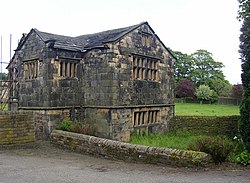
Kirklees Hall is a 16th-century Grade I listed Jacobean hall, close to the English village of Clifton in Calderdale, West Yorkshire. The first evidence of a hall constructed at Kirklees was that of Sir Thomas Gargrave, who conveyed the property to the Pilkington family. After the estate was acquired by the up-and-coming Armytage family, the stone built hall was altered c.1770 by John Carr for the Sir George Armytage, 3rd Baronet. The Armytage family went on to occupy the hall for several generations. Lady Armytage (d: 2008 aged 81), sold the property in 1983 and moved into Priory Gardens a property she built within Kirklees Park estate adjacent to Old Farm (formerly Low Hall) and the Kirklees Priory site. The former gatehouse part of the Old Farm (Low Hall) complex can still be seen, though the site is on private land and has no public access. Kirklees Hall and grounds designed after Francis Richardson are now a collection of luxury residences set in 18 acres and are annexed from Kirklees Park estate which are private with no public access.

Nearby Places View Menu
Location Image
384 m

Kirklees Priory

Kirklees Priory was a Cistercian nunnery whose site is in the present-day Kirklees Park, Clifton near Brighouse, Calderdale, West Yorkshire, England. It was originally in the ancient ecclesiastical parish of Dewsbury. The priory dedicated to the Virgin Mary and St James was founded by Reiner le Fleming, Lord of the manor of Wath upon Dearne, in 1155 during the reign of Henry II. The priory gives its name to the Kirklees metropolitan district council, formed in 1974 and including the towns of Huddersfield, Dewsbury and Batley, though the priory is just outside the district's boundary itself and is in neighbouring Calderdale. Nuns from the priory were involved in scandals between 1306 and 1315. Archbishop of York William Greenfield wrote to the prioress about rumours concerning Alice Raggid, Elizabeth Hopton, and Joan Heton. Rumours implied they had been seeing religious and secular men in the nunnery and their behaviour led to the house being considered one of disrepute. The priory was not dissolved by the Dissolution of the Lesser Monasteries Act in 1535, but continued for worship and hospitality. Cecilia Topcliffe was the prioress, and the convent consisted of the nuns who had been there on 4 February 1536, who continued as before the passing of the Act. In 1539, after the Second Act of Dissolution, Joan Kyppes surrendered the priory, which had eight inmates. At the date of surrender the whole property was worth £29 18s. 9d. The site was granted to John Tasburgh and Nicholas Savill; the church and priory buildings were demolished, and the stone was used to build Low Hall, now known as Old Farm. A local inn, The Three Nuns, was named after Cecilia Topclife, Joan Leverthorpe and Katherine Grace, who sought refuge at the site of a guesthouse of the priory and ran it as a hostelry. The present inn was built in 1939 and the site of the guest house is buried under the car park. All that remains of Kirklees Priory are the long double-aisled barn, and parts of the Old Farm House, calf house and the gatehouse; all are still standing as Old Farm. They are all Grade I listed buildings. The gatehouse was on Historic England's Heritage at Risk Register, but following extensive repair work was removed from the list. The landscaping of Kirklees Park was surveyed by the landscape gardener, Francis Richardson, in 1757. It contains a collection of medieval buildings preserved by the Armytage family since the 16th century. The priory is featured in the medieval legend of Robin Hood. According to the ballad Robin Hood's Death, Robin was killed by the prioress of Kirklees. She was medically treating Robin via bleeding, but treacherously drained too much of his blood instead. A monument in the woods near the River Calder claims to be Robin Hood's Grave.
Location Image
808 m

Robin Hood's Grave

Robin Hood's Grave is the name given to a monument in Kirklees Park Estate, West Yorkshire, England, near the now-ruined Kirklees Priory. It is alleged to be the burial place of English folk hero Robin Hood.
Location Image
1.2 km

Hartshead

Hartshead is a village in the Kirklees district of West Yorkshire, England, 3.7 miles (6 km) west of Dewsbury and near to Hartshead Moor. The village has pre-Norman Conquest origins; the Walton Cross is believed to be dated from the 11th century. The name Hartshead is derived from Herteshevet or Herteshede which is Scandinavian in origin and means Hill of Heort, Heort meaning Hart in modern English. Patrick Brontë served as curate of St Peter's Church in Hartshead between 1811 and 1815, in which time he met his wife, Maria Branwell (although they met in Rawdon, some dozen or so miles away from Hartshead). They were married in Guiseley and became the parents of Anne, Branwell, Charlotte and Emily Brontë. Kirklees Hall is between Hartshead and the nearby village of Clifton. Robin Hood is reputed to have been buried near Hartshead or in the grounds of the nearby Kirklees Hall. The exact place is not known, as the gravestone has been moved at least 3 times.
Location Image
1.4 km

Clifton, West Yorkshire

Clifton is a village on the eastern outskirts of Brighouse in the Calderdale district of West Yorkshire, England.