


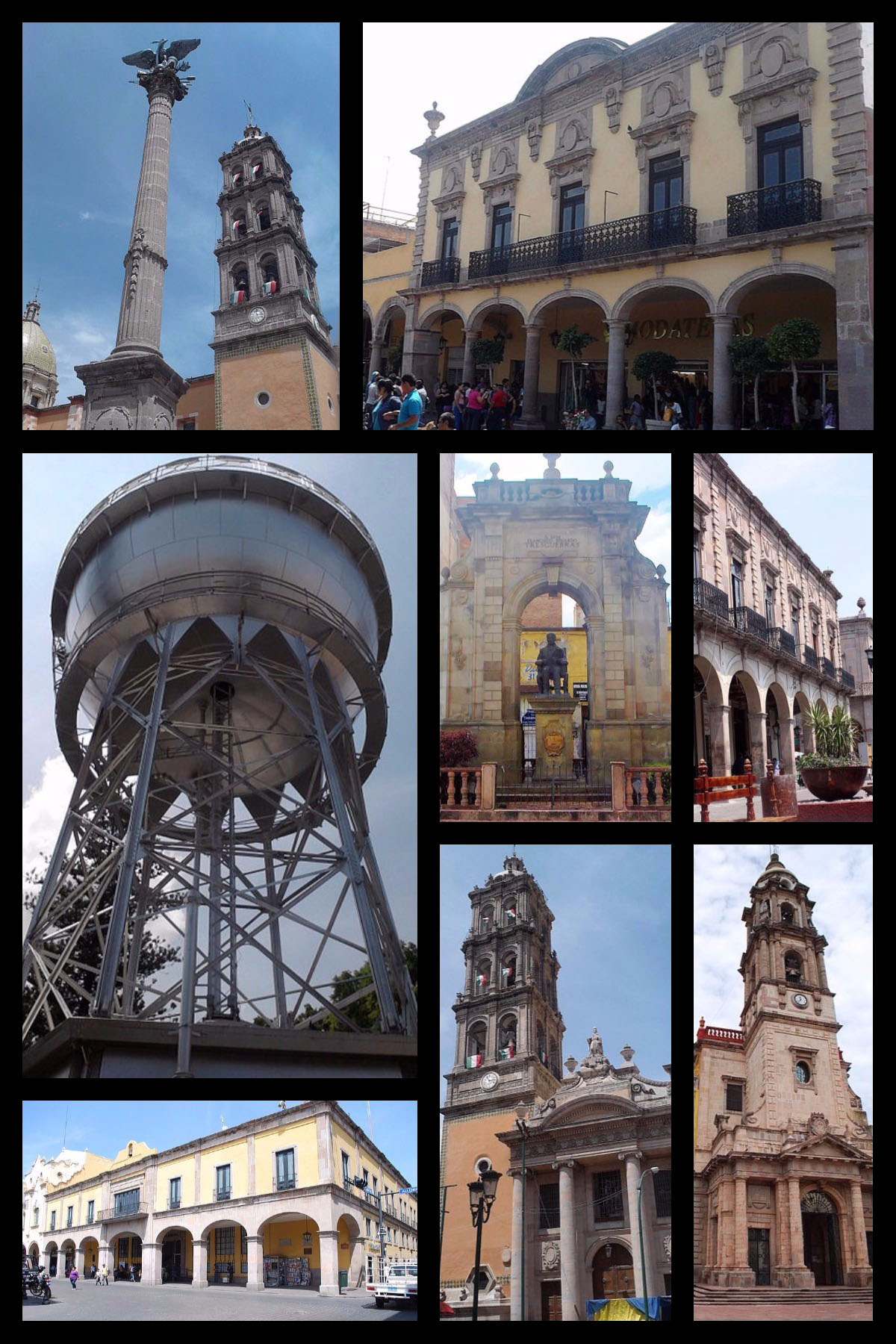
Celaya est une localité et le chef-lieu de la municipalité de Celaya, dans l'État du Guanajuato, au Mexique.
Location
1 explorer visited this place

0 m
Celaya is a city and its surrounding municipality in the state of Guanajuato, Mexico, located in the southeast quadrant of the state. It is the third most populous city in the state, with a 2005 census population of 310,413. The municipality for which the city serves as municipal seat, had a population of 415,869. The city is located in the geographic center of the municipality, which has an areal extent of 553.1 km2 and includes many smaller outlying communities, the largest of which are San Miguel Octopan, Rincón de Tamayo and San Juan de la Vega.
There are many smaller towns around Celaya including Rincón de Tamayo, Tarimoro, Villagrán, La Moncada, Panales Jamaica, Panales Galera, La Calera, La Estancia, La Noria, Los Fierros, El Acebuche, Cacalote, and Charco Largo. It is also not far away from Cortazar, Salamanca, Salvatierra, Apaseo el Grande, Querétaro City and among others. The city was founded in 1570 as Villa de la Purisíma Concepción de Zalaya. The word Zalaya is of Basque origin and means "Flat Land".

35 m
The Diocese of Celaya is a suffragan diocese of the Archdiocese of León. It was a suffragan of the Archdiocese of San Luis Potosí until 25 November 2006.

55 m
The Immaculate Conception Cathedral, also Celaya Cathedral, is the main Catholic building in the city of Celaya in Mexico, occupying at present what was the space of a chapel annexed to the Temple of St. Francis. Because of the size of this last temple, it has come to confuse the Temple of St. Francis with the cathedral, a common mistake.
The San Francisco Temple was erected by the Franciscan Order, who evangelized in the place, having originally built a small chapel of smaller proportions, as well as the convent attached. The first stone of this temple was erected on February 2 of the year 1683. The Cathedral of Celaya is not the Temple of San Francisco. The cathedral is located to the side of the aforementioned Franciscan temple and has been administered for many years by the diocesan clergy.
The advances in the work were slow; by 1715 the vaults had been closed, and by the year 1725 the tower was completed.
Remodeled at the beginning of the 19th century, and at the beginning of the 20th century. It also suffered a fire, by which the last remodeling was carried out, in which was added a German organ of good bill, placed in the part of the choir.

772 m
The 12th federal electoral district of Guanajuato is one of the 300 electoral districts into which Mexico is divided for elections to the federal Chamber of Deputies and one of 15 such districts in the state of Guanajuato.
It elects one deputy to the lower house of Congress for each three-year legislative session by means of the first-past-the-post system. Votes cast in the district also count towards the calculation of proportional representation deputies elected from the second region.
Suspended in 1930,
Guanajuato's 12th was re-established as part of the 1977 political reforms. The restored district returned its first deputy in the 1979 mid-term election.
The current member for the district, elected in the 2024 general election, is María Magdalena Rosales Cruz of the National Regeneration Movement.

1.6 km
The Estadio Miguel Alemán Valdés is a multi-use stadium in Celaya, Guanajuato. Mexico. It is currently used mostly for football matches and is the home stadium of Club Celaya. The stadium holds 23,369 people and opened in 1954.
It is named for Miguel Alemán Valdés, President of the Republic from 1946 to 1952.
On 2 June 2016, it was announced that the stadium was renamed in honour of former Real Madrid player Emilio Butragueño, who played the last three years of his career for Atlético Celaya, it was later denied by Ramón Lemus Muñoz, the Municipal president of Celaya.
Book your tour near
Celaya
Book Now
4.4
in partnership with
GetYourGuide.com