
Location Image

Millennium Square, Sheffield

Millennium Square is a modern city square in Sheffield, England. It was created as part of the Heart of the City project that began in 1998 and has become a central feature in Sheffield's redeveloped city centre. It contains fountains in the shape of steel spheres, recalling Sheffield's past as a centre of the steel making industry, whilst linking with the fountains of the Peace Gardens, as well as Sheaf Square, Hallam Square and Barkers Pool. The square forms part of the 'Gold Route', designed by Sheffield City Council to guide visitors through the city centre from Sheffield Station to Devonshire Green. Part of the space now part of the square was previously occupied by the Town Hall Extension. This building, constructed in the 1970s, was demolished in the early 2000s to make way for the wave of new developments in the Heart of the City project.

The Square, which is in fact triangular, was designed by Architects Allies and Morrison and is surrounded by new developments on three sides and the redeveloped Peace Gardens on the remaining side. The surface of the square is made up of a suspended concrete slab covered with granite and sandstone paving. The surface is covered with hundreds of LED lights which are used to illuminate both square itself and the steel water features throughout it. The square is intended to form a link between the Winter and Peace Gardens and also the St Paul's Place development, which is home to Sheffield's tallest building. The square is surrounded in all sides by new or renovated structures, with the Peace Gardens and Town Hall on one side and a multitude of new buildings on the three remaining sides.

Nearby Places View Menu
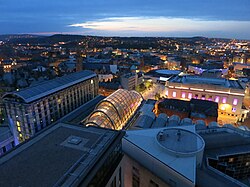
Location Image
52 m

Sheffield Winter Garden

Sheffield Winter Garden is a large temperate glasshouse located in the city of Sheffield in South Yorkshire, England. It is one of the largest temperate glasshouses to be built in the UK during the last hundred years, and the largest urban glasshouse anywhere in Europe. It is home to more than 2,000 plants from all around the world. It was officially opened by Queen Elizabeth II on 22 May 2003.
Location Image
71 m

St Paul's Tower

St Paul's Tower is a skyscraper located on Arundel Gate in Sheffield, South Yorkshire, England. Construction commenced in May 2006 and the building was topped out in August 2010, surpassing Sheffield University's Arts Tower as the tallest building in Sheffield at 101 metres (331 ft) tall. The city's first skyscraper, it was constructed as the centrepiece of the St Paul's Place project as part of the Heart of the City redevelopment of Sheffield city centre.
Location Image
88 m

Millennium Gallery

The Millennium Gallery is an art gallery and museum in the centre of Sheffield, England. Opened in April 2001 as part of Sheffield's Heart of the City project, it is located in the city centre close to the mainline station, the Central Library and Graves Art Gallery, Sheffield Hallam University, and Sheffield Theatres. Designed by architects Pringle Richards Sharratt, the building is primarily made from concrete and glass, with a series of galleries extending from a central avenue, which connects Arundel Gate with Sheffield Winter Garden. In 2011, the gallery was listed as the 15th most-visited free attraction in the country by Visit England. It is managed by Museums Sheffield. The gallery has two permanent collections, two temporary exhibition spaces, space for corporate events and weddings, and a cafe and shop.
Location Image
94 m

St Paul's Church, Sheffield

See also St Paul's Church and Centre, Norton Lees, Sheffield and Sheffield Cathedral, which is dedicated to St Peter and St Paul. St Paul's Church, Sheffield, was a chapel of ease to Sheffield Parish Church. By 1700, Sheffield's population had reached 5,000, and a second Anglican place of worship was required to house a growing congregation. A site on the southern edge of the town was selected, facing on to Pinstone Lane (later redeveloped as Pinstone Street). A public subscription was raised, and St Paul's was largely completed by 1721. The church was built in the Baroque style, with the street frontage dominated by an Italianate tower. The chapel had seating for 1,200 people. A dispute over patronage prevented the chapel from opening until 1740. Robert Downes, a local goldsmith, had paid £1,000 towards its construction and promised a further £30 a year, on condition that he and his descendants would have the right to appoint its minister. However, the Vicar of Sheffield objected that, as St Paul's was a chapel of ease to his own church, he had the right to appoint a minister. In 1739, angered by the stand-off, Downes threatened to open the building as a chapel for Dissenters. A compromise was finally reached that the Vicar would have the right to choose the minister, but that the first minister would be a relative of Downes. This required an Act of Parliament, following which, it was consecrated to Saint Paul on 22 May 1740. A John Snetzler organ was installed in 1755. A dome was added to the chapel's tower in 1769. In 1824, the church was placed in its own parish. A memorial to Reverend Alexander Mackenzie, designed by Francis Legatt Chantrey, was added around this time. Following the trend of supposed slum clearance in the 1930s, the church's congregation dwindled, and St Paul's closed in 1937. It was demolished the following year, and the St Paul's Gardens were laid out on the site, later becoming known as the Peace Gardens. The organ was removed to All Saints in Wingerworth, while the Chantrey memorial was moved to Sheffield Cathedral. Many of the remains in the burial ground were relocated to Abbey Lane Cemetery. Some of the old stone was repurposed by the contractor who demolished the church, and can still be seen in a row of houses built in suburbs west of the city.